
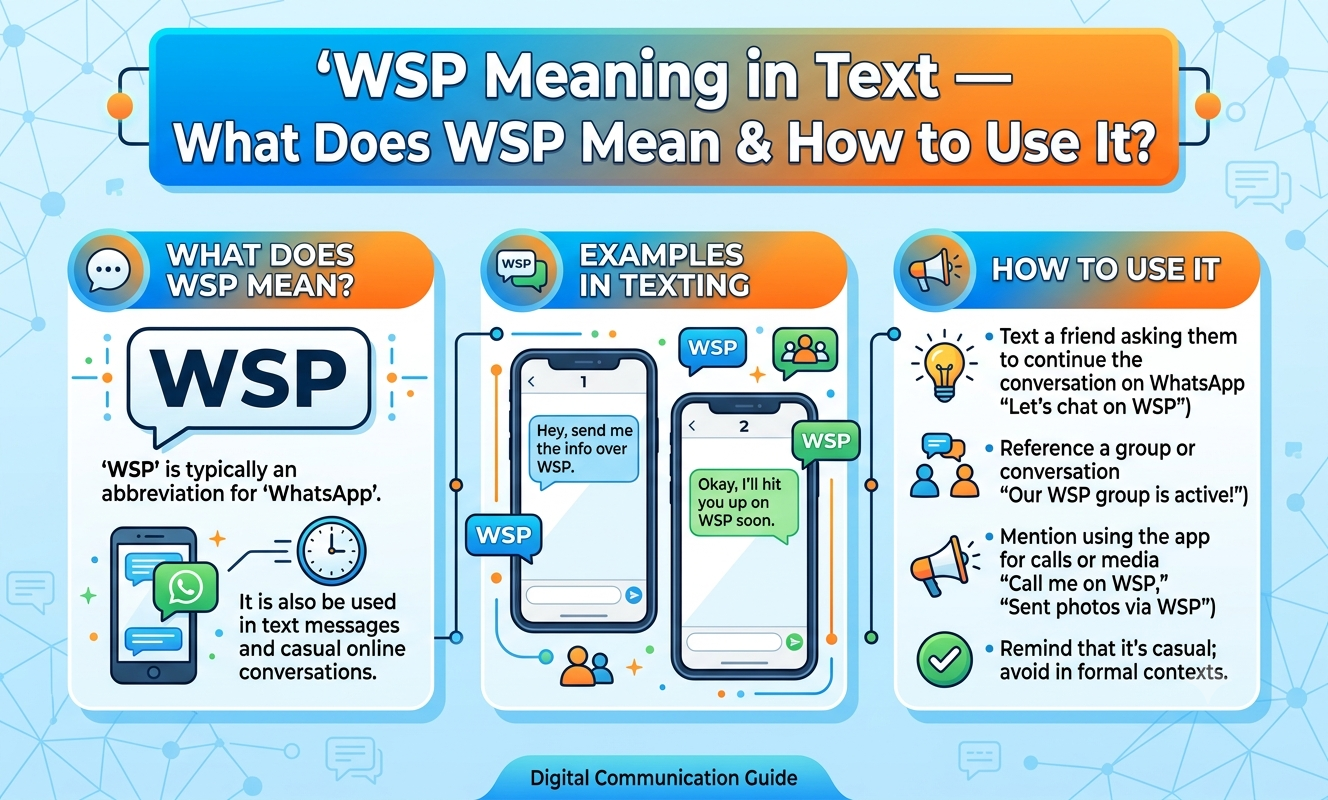
introduction to WSP Meaning in Text
Quick Answer: WSP in texting means “What’s Up?” — a short, casual way to ask someone how they’re doing or what they’re up to. It’s most common as a greeting when starting a chat. In Spanish-speaking regions, “wsp” is also used informally to refer to WhatsApp itself.
Introduction
You get a text that just says “wsp” and nothing else. No punctuation, no context — just three letters staring back at you. What does WSP mean in text, and more importantly, how are you supposed to reply?
If you’ve seen this abbreviation pop up on WhatsApp, Snapchat, or in a group chat and felt momentarily confused, you’re not alone. WSP is one of those texting shortcuts that looks cryptic at first but is actually one of the simplest and friendliest greetings out there.
In this guide, you’ll learn exactly what WSP stands for, where it came from, how it’s used across different apps in 2026, whether it can come across as rude, and how to reply to it naturally. We’ll also cover similar slang terms so you’re never caught off guard again.
What Does WSP Mean?
WSP is a shortened, phonetic spelling of “What’s Up?” — a casual greeting used to check in with someone or open a conversation. It’s part of a broader family of texting abbreviations that trim words down to their essential sounds to save time and keystrokes.
The phrase “what’s up” itself has been part of casual English greetings for decades, popularized through everyday conversation and later through pop culture and advertising. As texting and instant messaging took off, users began compressing common phrases into shorter forms — “wsp,” “wassup,” “sup,” and “wyd” (what you doing) all emerged from this same trend.
By 2026, WSP has become fully embedded in everyday digital communication, especially among teens and young adults who move quickly between texting, DMs, and voice-note culture. It’s now common not just as a written greeting but also as something people say out loud in a joking, exaggerated tone when referencing internet speak.
There’s also a second meaning worth knowing: in many Spanish-speaking countries, “wsp” (or “whats”) is used as informal shorthand for the app WhatsApp itself — as in “mándame un wsp” (send me a WhatsApp message). Context usually makes it clear which meaning is intended.
WSP Full Form Explained
WSP isn’t a traditional acronym where each letter stands for a separate word — it’s a phonetic abbreviation, meaning the letters represent the sounds of the phrase rather than individual words.
| Letter | Represents | Sound |
|---|---|---|
| W | What’s | “Wh” sound |
| S | (s) | The “s” in “what’s” |
| P | P (short for “up”) | The “p” sound at the end of “up” |
In short: W-S-P = “What’s + (u)P” = “What’s Up?”
Unlike acronyms such as LOL (Laugh Out Loud) or BRB (Be Right Back), WSP doesn’t expand into a full sentence letter-by-letter. It’s simply a compressed spelling meant to be read quickly and understood instantly.
How to Use WSP — Real Examples
WSP is flexible. It can open a conversation, check on someone’s mood, or just be a low-effort way to say hello. Here’s how it plays out in different emotional contexts.
| Situation | Example | Emotion |
|---|---|---|
| Starting a casual chat | “wsp, you free later?” | Neutral / Friendly |
| Checking on a friend | “wsp, haven’t heard from you in a while” | Concerned |
| Flirty opener | “wsp cutie 👀” | Playful / Flirty |
| Group chat greeting | “wsp everyone, big news” | Excited |
| After an argument | “wsp… you good?” | Cautious |
| Late-night text | “wsp, can’t sleep” | Bored / Reflective |
| Replying to a story or post | “wsp with this pic lol” | Curious / Amused |
| Business-casual (close coworkers) | “wsp, did you see the update?” | Neutral |
| Sarcastic tone | “oh wsp, look who decided to text back” | Sarcastic |
| Comforting a friend | “wsp, I’m here if you wanna talk” | Supportive |
Notice how the same three letters shift meaning entirely based on punctuation, emojis, and surrounding words — this is common with almost all texting slang.
WSP on Different Platforms (2026)
Texting slang doesn’t behave the same way on every app. Each platform has its own culture, and WSP shows up a little differently depending on where you see it.
On WhatsApp
WhatsApp remains one of the most widely used messaging apps globally in 2026, and “wsp” is especially common here — partly because the app’s own name sounds close to the abbreviation. In Spanish-speaking countries, “wsp” often doubles as slang for the app itself, not just the greeting.
On Snapchat
On Snapchat, WSP tends to show up as an opener in chats or as a caption on Snaps, often paired with a selfie or a “what are you doing right now” moment. Because Snapchat conversations are usually short and fast-paced, WSP fits naturally as a low-effort check-in.
On TikTok
On TikTok, WSP shows up less as a private greeting and more inside comment sections, duets, or captions — sometimes used ironically or as a nod to internet-speak culture rather than a genuine question. Creators occasionally use it in a playful, self-aware way when referencing “text-speak.”
On Instagram
On Instagram, WSP is common in DMs, especially as an opener to someone’s story reply or as a first message. It’s also seen in comment threads as a lighthearted way to tag a friend and get their attention.
Across all these platforms, the underlying trend in 2026 is the same: shorter, faster, more informal communication continues to dominate, and abbreviations like WSP remain a staple because they get straight to the point without feeling stiff.
Is WSP Rude or Offensive?
WSP itself is not rude or offensive — it’s a neutral, casual greeting. However, context and relationship matter a lot here.
Why some people find it off-putting:
- Sent with no punctuation or emoji, it can feel abrupt or low-effort, especially in a first message.
- In a professional or unfamiliar setting, it may come across as too casual.
- If someone is upset with you, a plain “wsp” can feel dismissive rather than caring.
Why it’s usually fine:
- Between friends or people who text casually, it’s completely normal and friendly.
- It’s often used precisely because it’s low-pressure — there’s no expectation of a long reply.
- Adding a warm follow-up (“wsp, missed you!”) instantly softens the tone.
The general rule: WSP is only as rude as the relationship and context allow. With close friends, it’s harmless. With someone new or in a formal setting, a slightly longer greeting is usually safer.
How to Reply to WSP
Not sure what to say back? Here are natural ways to respond depending on your mood or situation.
| Reply Type | Example Response | When to Use |
|---|---|---|
| Casual/Neutral | “not much, you?” | Everyday reply |
| Enthusiastic | “omg wsp!! been forever” | Excited to hear from them |
| Busy/Short | “kinda busy rn, talk later?” | You can’t chat right now |
| Honest/Vulnerable | “not great tbh, long day” | You want to open up |
| Flirty | “just thinking about you 👀” | Playful back-and-forth |
| Deflecting | “nothing much, wsp with you?” | You’d rather they go first |
A good rule of thumb: match their energy. A short “wsp” usually invites a short reply, while a longer or more emotional “wsp” often deserves a fuller response.
WSP Alternatives and Similar Slang
WSP belongs to a whole family of casual greeting abbreviations. Here are other common ones you’ll run into.
| Term | Meaning |
|---|---|
| Sup | Short for “what’s up,” even more casual than WSP |
| Wassup | A phonetic, playful spelling of “what’s up” |
| WYD | “What you doing?” — asks about current activity |
| HBU | “How about you?” — used after answering a question |
| HRU | “How are you?” — a slightly more caring check-in |
| Yo | Simple attention-grabbing greeting |
| WYA | “Where you at?” — asks about location |
| Hola/Ke onda | Spanish-language greetings sometimes mixed with English slang |
These terms often get used interchangeably depending on personal texting style, regional slang, and the platform being used.
Frequently Asked Questions (FAQ)
Q: What does WSP mean in text? A: WSP means “What’s Up?” — a casual greeting used to start a conversation or check in on someone.
Q: Is WSP the same as WhatsApp? A: Not exactly. WSP primarily means “what’s up,” but in some Spanish-speaking regions it’s also used informally as shorthand for the WhatsApp app.
Q: How do you reply to WSP in a text? A: You can reply with something simple like “not much, you?” or match the tone of the message — casual for a casual “wsp,” warmer for a more personal one.
Q: Is WSP rude to send someone? A: No, WSP isn’t inherently rude. It can feel abrupt without context, but between friends it’s a normal, friendly greeting.
Q: What’s the difference between WSP and WYD? A: WSP asks generally “what’s up,” while WYD (“what you doing”) asks specifically about the person’s current activity.
Q: Do people still use WSP in 2026? A: Yes. WSP remains a common, everyday greeting across messaging apps and social platforms, especially among teens and young adults who favor quick, informal texting.
Conclusion
WSP is simply a fast, friendly way of saying “what’s up” — a texting habit that saves time without losing warmth. Whether you see it on WhatsApp, Snapchat, TikTok, or Instagram, it usually just means someone wants to say hi or start a conversation with you.
Now that you know the full meaning behind WSP, how to use it, and how to reply, you’ll never have to pause and wonder again. Bookmark this page next time a text abbreviation leaves you scratching your head.
Also read SM Meaning in Text — What Does SM Mean & How to Use It?
