
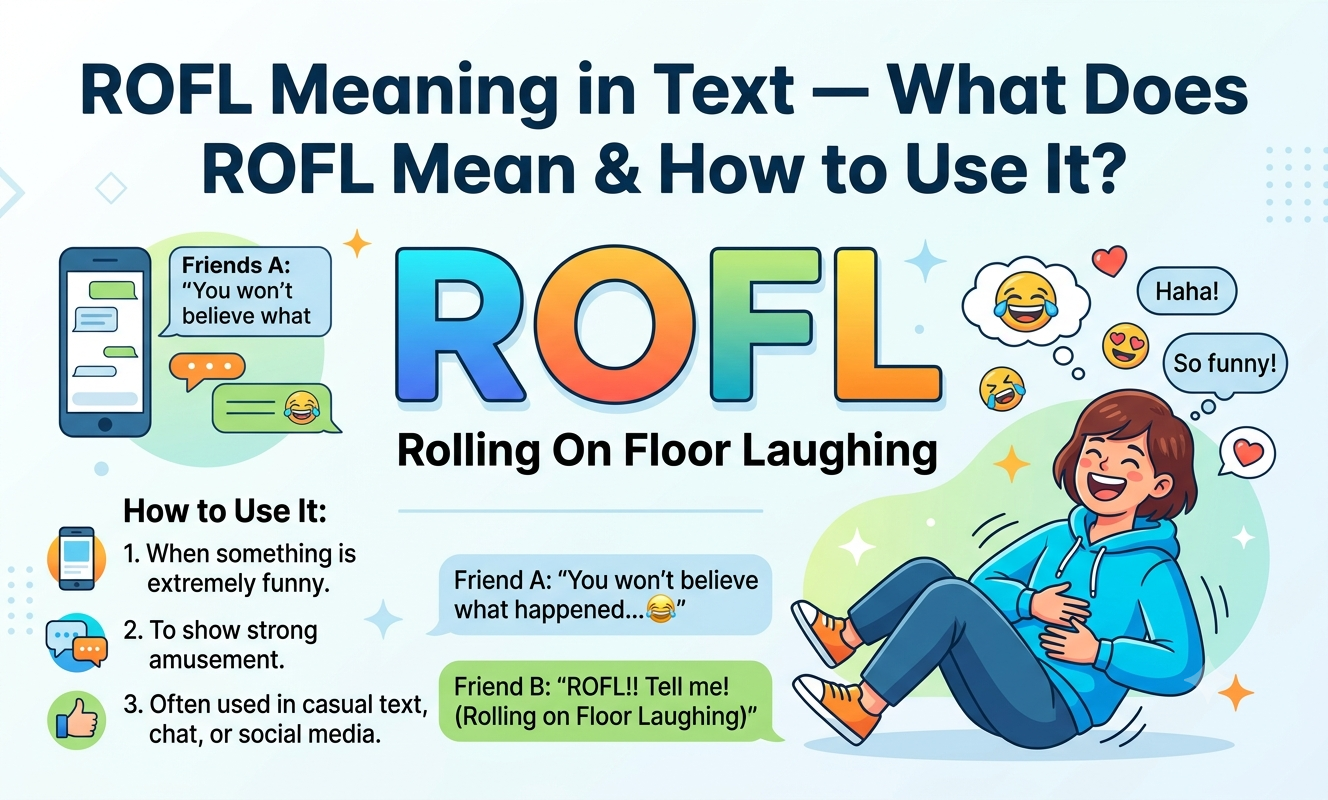
Quick Answer: ROFL meaning in text is “Rolling On the Floor Laughing.” It’s used in texts, DMs, and comments to show that something is so funny you’d physically fall over laughing. It’s a step above LOL and is usually reserved for the truly hilarious stuff.
Introduction
Ever gotten a text so funny you typed back “ROFL” without even thinking twice? You’re not alone. Millions of people use this one every single day, but not everyone knows exactly where it came from or when to use it instead of LOL or LMAO.
The rofl meaning in text is simple: it stands for “Rolling On the Floor Laughing,” and it’s meant to describe a reaction that’s bigger than a chuckle — the kind of laugh that would genuinely knock you off your chair.
In this guide, you’ll learn where ROFL came from, how it’s used across WhatsApp, Snapchat, TikTok, and Instagram in 2026, whether it can come across as rude, and how to reply when someone sends it your way. Let’s get into it.
What Does ROFL Mean?
ROFL stands for “Rolling On the Floor Laughing.” It’s an internet acronym used to express that something is extremely funny — funnier than a simple “haha” or “lol” would suggest.
ROFL first showed up in early internet chatrooms and message boards back in the 1990s, alongside other classics like LOL and BRB. It became a staple of instant messaging culture through the 2000s, and even though texting habits have shifted a lot since then, ROFL has held on.
By 2026, ROFL is still widely recognized across every major messaging app and social platform, even as GIFs, emoji reactions, and voice notes have become more common ways to express humor. It’s become something of a “classic” internet term — the kind Gen Z uses half-ironically and parents use completely sincerely, which somehow keeps it relevant across every age group.
ROFL Full Form Explained
Here’s the acronym broken down letter by letter:
| Letter | Stands For |
|---|---|
| R | Rolling |
| O | On the |
| F | Floor |
| L | Laughing |
Put together, it paints a picture: laughing so hard that you’re not just sitting there smiling — you’re doubled over, practically falling out of your chair.
How to Use ROFL — Real Examples
ROFL fits naturally into casual conversations, group chats, and comment sections. Here are examples across different emotional contexts:
| Situation | Example | Emotion |
|---|---|---|
| Friend sends a meme | “ROFL this is literally me every Monday” | Amusement |
| Something goes wrong hilariously | “He tripped into the pool ROFL I can’t breathe” | Shock + laughter |
| Sarcastic reply | “ROFL sure, and I’m the Queen of England” | Playful sarcasm |
| Group chat inside joke | “ROFL only we would understand this” | Bonding |
| Reacting to a funny video | “ROFL send me the link right now” | Excitement |
| Embarrassing story shared | “ROFL wait you actually did that??” | Disbelief + humor |
| Teasing a friend | “ROFL you’re so dramatic omg” | Light teasing |
| Funny typo or autocorrect fail | “ROFL autocorrect really said that” | Surprise |
| Reacting to a pun | “ROFL okay that one actually got me” | Reluctant laughter |
| Late-night texting | “ROFL why are we like this at 2am” | Silliness |
ROFL on Different Platforms (2026)
Every platform has its own texting culture, and ROFL shows up a little differently on each one.
On WhatsApp
WhatsApp remains one of the most text-heavy platforms, especially for family and friend groups. ROFL is common here because voice notes and long messages still leave room for quick text reactions, and many users pair it with the 😂 emoji for extra emphasis.
On Snapchat
On Snapchat, conversations move fast and casually. ROFL often appears as a quick reply to a funny Snap or a chat message, frequently shortened even further in fast back-and-forth exchanges.
On TikTok
In TikTok comments, ROFL is used to react to funny videos, often stacked with other laughing acronyms or emoji strings like “ROFL 😭😭😭” to show an over-the-top reaction to a clip.
On Instagram
On Instagram, ROFL shows up in DMs and comment sections, especially under funny Reels or meme posts. It’s often used alongside GIFs, since Instagram makes it easy to react visually as well as with text.
Across all these platforms in 2026, text-based reactions like ROFL still hold their ground even as emoji reactions and quick-tap responses have grown. That’s largely because typing out ROFL still feels more personal and expressive than a single tap.
Is ROFL Rude or Offensive?
ROFL is not considered rude or offensive on its own. It’s simply a way to express strong amusement.
That said, context matters. If someone shares something serious, embarrassing, or upsetting, and you reply with “ROFL,” it can come across as insensitive — even if you didn’t mean it that way. The term is meant for genuinely funny moments, not for laughing at someone’s expense.
In short: use ROFL when something is objectively funny, and read the room before using it in response to a story that might actually be a sensitive one for the other person.
How to Reply to ROFL
If someone sends you “ROFL,” here are a few natural ways to respond:
| Their Message | Your Reply | Tone |
|---|---|---|
| “ROFL that video was insane” | “Right?? I couldn’t stop laughing either” | Agreeing |
| “ROFL you’re so unserious” | “Lmaooo I know, I can’t help it” | Playful |
| “ROFL I can’t with you” | “😂😂 what did I even say” | Curious |
| “ROFL this made my whole day” | “Glad I could help, that was too good” | Warm |
| “ROFL no way that happened” | “I wish I was joking, it actually did” | Storytelling |
| “ROFL send more” | “Say less, here’s another one” | Enthusiastic |
ROFL Alternatives and Similar Slang
There are plenty of other acronyms that express laughter, each with a slightly different intensity or tone:
| Term | Meaning |
|---|---|
| LOL | Laughing Out Loud (mild to moderate laughter) |
| LMAO | Laughing My *** Off (stronger laughter) |
| LMFAO | An even more intense version of LMAO |
| ROTFL | Rolling On The Floor Laughing (same as ROFL) |
| HAHA / LMAOO | Casual, spelled-out laughter |
| DEAD / I’M DECEASED | Modern slang for extreme laughter |
| CRYING | Used to describe laughing so hard you’re in tears |
| 😭😂 (emoji combo) | A visual stand-in for intense laughter |
Frequently Asked Questions (FAQ)
Q: What is the rofl meaning in text? A: ROFL means “Rolling On the Floor Laughing.” It’s used to show that something is extremely funny.
Q: Is ROFL the same as LOL? A: Not exactly. LOL suggests mild to moderate amusement, while ROFL implies a much stronger, over-the-top reaction.
Q: When did ROFL become popular? A: ROFL originated in 1990s internet chat culture and has remained popular through decades of texting and social media, still widely used in 2026.
Q: Can ROFL be used in professional messages? A: It’s best kept casual. ROFL fits friends, family, and informal group chats, but isn’t ideal for formal or workplace communication.
Q: Is ROFL still used in 2026, or is it outdated? A: ROFL is still actively used, especially in text and comments, even though emoji and GIF reactions have become more common alongside it.
Q: What’s the difference between ROFL and ROTFL? A: They mean the same thing — “Rolling On The Floor Laughing.” ROTFL just includes the extra “the,” while ROFL is the shorter, more common version.
Conclusion
ROFL is a simple, lighthearted way to show someone that they’ve truly made you laugh — more than a giggle, less than an actual fall off your chair, but somewhere close. Knowing the full rofl meaning in text helps you use it naturally, whether you’re texting on WhatsApp, replying to a Snap, or commenting on a TikTok video.
Now that you know where it came from, how to use it, and how to reply to it, you’re all set to drop it into your next conversation with confidence. Bookmark this page next time you need a quick refresher on ROFL or any other texting slang.
Also read OOTD Meaning in Text — What Does OOTD Mean & How to Use It?
