
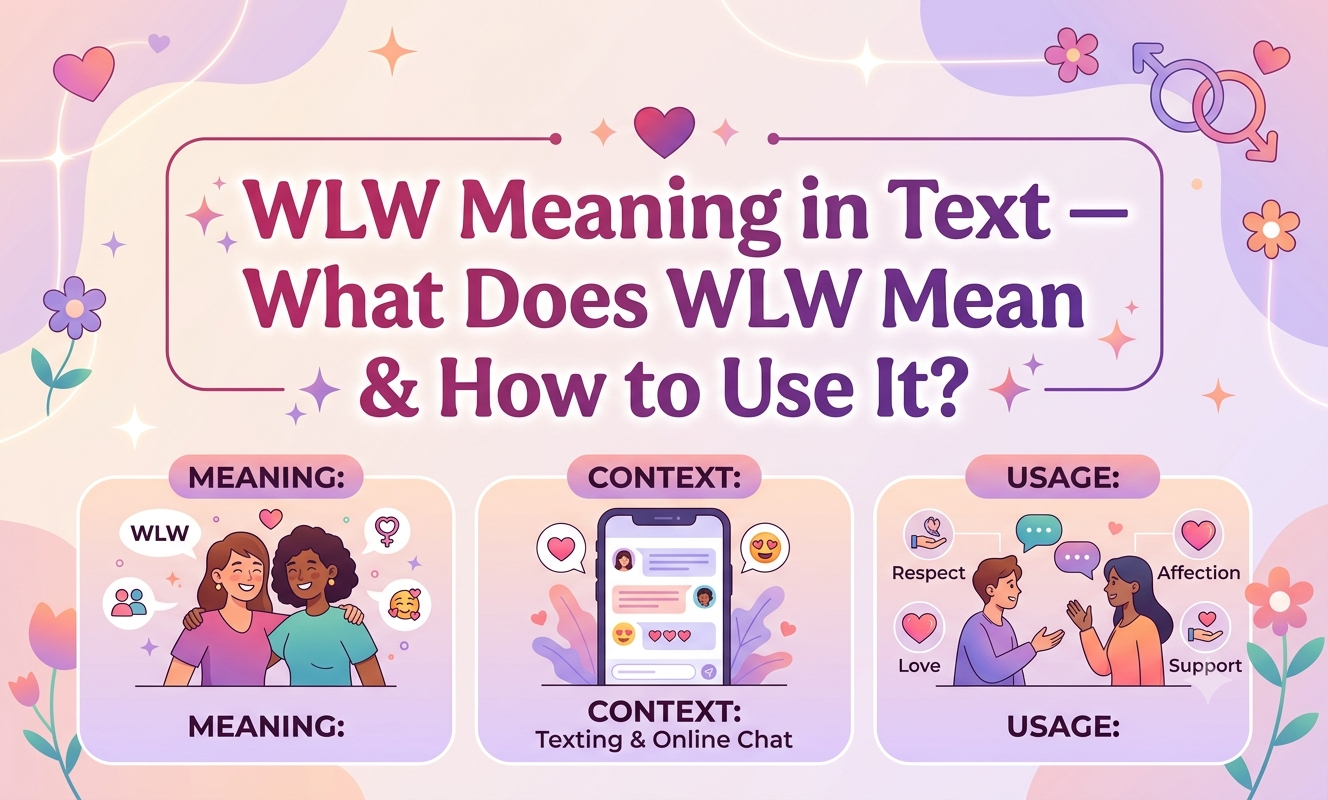
Quick Answer: WLW stands for “Women Loving Women.” It’s a term used to describe romantic or emotional attraction between women, including lesbian, bisexual, and other sapphic identities. People use it in texts, bios, and captions as a short, inclusive way to talk about who they love.
Introduction
Scrolling through TikTok or Instagram and seen the letters WLW in someone’s bio or caption and wondered what it means? You’re not alone. The wlw meaning in text is simple once you know it, but it can look confusing if you’ve never come across it before.
This guide breaks down exactly what WLW means, where it came from, how people use it across different apps in 2026, and how to reply if someone uses it with you. Whether you’re a teen trying to keep up with online language or a parent trying to understand your kid’s texts, you’ll find clear, simple answers here.
What Does WLW Mean?
WLW stands for “Women Loving Women.” It’s a short, everyday term used to describe romantic, emotional, or physical attraction between women. This includes lesbian women, bisexual women, and other women who are attracted to women.
The term is meant to be broad and welcoming. Instead of asking someone to label their exact orientation, WLW lets people describe their experience in a simple, low-pressure way.
WLW isn’t a brand-new term — it’s been used in LGBTQ+ communities online for over a decade. But by 2026, it has become mainstream enough that it shows up regularly in mainstream slang glossaries, dating app bios, and everyday texting between friends, not just in niche forums. Younger internet users now use it almost as casually as they’d use “couple goals” or “besties.”
The term first spread through LGBTQ+ forums and Tumblr blogs in the early 2010s, where it offered a way to talk about sapphic relationships without needing a single, fixed label. Over time it moved from niche community spaces to mainstream social platforms, growing alongside other identity-based shorthand like MLM and NBLW.
By 2026, WLW has settled into everyday internet vocabulary. It’s common in Pride Month posts, relationship content, book and movie recommendations, and even in school-age conversations as teens become more familiar with LGBTQ+ terminology. Parents encountering the term in a child’s messages are usually seeing a normal part of how identity and relationships get discussed online today — not something alarming.
One reason WLW has stuck around is its flexibility. Instead of forcing someone into a single box, it works as a general descriptor that many different women — lesbian, bisexual, pansexual, or still exploring — can use to describe their experience. That openness is part of why it continues to trend across apps.
WLW Full Form Explained
Breaking the acronym down letter by letter makes it easy to remember:
| Letter | Stands For | Meaning |
|---|---|---|
| W | Women | Refers to women or people who identify as women |
| L | Loving | Describes romantic or emotional attraction |
| W | Women | Refers again to women — the object of that attraction |
So put together: Women Loving Women — women who love, date, or are attracted to other women.
You may also see the related term MLM, which stands for “Men Loving Men” and works the same way for gay and bisexual men.
How to Use WLW — Real Examples
WLW can be used in a caption, a bio, a text, or just a casual comment. Here are examples across different emotional contexts:
| Situation | Example | Emotion |
|---|---|---|
| Instagram bio | “wlw 🏳️🌈 taken by the best girl ever” | Pride |
| Texting a friend | “omg that couple in the show is so wlw coded” | Excitement |
| TikTok caption | “wlw date night ideas that don’t cost a fortune” | Fun |
| Coming out to a friend | “I think I’m wlw, still figuring things out” | Vulnerable |
| Supporting a friend | “I’m so happy you told me, your wlw journey is valid” | Supportive |
| Book/movie review | “this book has the softest wlw romance arc” | Warm |
| Dating app bio | “wlw looking for someone who loves hiking” | Confident |
| Community post | “wlw creators you should be following in 2026” | Informative |
| Celebrating a milestone | “one year with my favorite person, wlw forever 💕” | Joyful |
| Casual chat | “not me being wlw and still crushing on her” | Playful |
WLW on Different Platforms (2026)
Each platform has its own flavor of how WLW gets used. Here’s how it shows up in 2026.
On WhatsApp
WhatsApp usage tends to be more personal and private. People mostly use WLW in one-on-one chats — often when talking about their own identity to a close friend or explaining a relationship status quietly, since WhatsApp doesn’t have public bios like Instagram.
On Snapchat
On Snapchat, WLW often appears in Snap captions or Stories, usually paired with couple photos or “day in my life” content. Because Snapchat feels more casual and less public than Instagram, users are often more open here with close friend groups.
On TikTok
TikTok is where WLW content has grown the most by 2026. The hashtag is used on relationship videos, coming-out stories, “get ready with me” content, and skits. TikTok’s algorithm has made WLW creators and couples far more visible, and the term now appears in video captions almost as often as it does in comments.
On Instagram
Instagram remains a popular place for WLW to appear in bios, especially alongside a pride flag emoji or a partner’s name. It’s also common in caption tags for couple posts, anniversary posts, and Pride Month content.
2026 Trend Note: Across all platforms, WLW is increasingly used not just by the LGBTQ+ community itself but also by allies sharing supportive content, book recommendations, or Pride-related posts.
Another shift in 2026 is how brands and content creators use the term. Publishers now regularly tag books with “wlw romance” to help readers find sapphic stories, and streaming platforms use similar tags in show descriptions. This has made the term far more visible to people outside LGBTQ+ community spaces, which is part of why parents and older users are seeing it more often in everyday texts and captions.
Search interest in terms like “wlw meaning in text” has also grown steadily, reflecting how often people — especially parents and younger teens — come across the acronym for the first time and want a quick, clear explanation.
Is WLW Rude or Offensive?
WLW itself is not rude or offensive. It’s a neutral, descriptive term that many people use proudly to describe their identity or relationships.
That said, context matters:
- When used respectfully or by someone describing their own identity — it’s completely fine and often a positive, empowering term.
- When used to mock, label someone without consent, or as a joke at someone’s expense — it can come across as disrespectful, even if the word itself isn’t a slur.
The general rule: it’s fine to use WLW to describe yourself or to talk about WLW content, relationships, or creators respectfully. It’s not okay to use it to guess or “out” someone without their permission.
How to Reply to WLW
Not sure how to respond if a friend uses WLW in a text or tells you they’re WLW? Here are some simple, supportive replies:
| Their Message | Your Reply | Tone |
|---|---|---|
| “I think I’m wlw” | “Thanks for telling me, that means a lot 💛” | Supportive |
| “wlw and proud 🏳️🌈” | “That’s amazing, I’m proud of you!” | Encouraging |
| “wlw date night idea?” | “How about a cozy movie night or a picnic?” | Helpful |
| “she’s my wlw person” | “You two are so cute together!” | Warm |
| “still figuring out if I’m wlw” | “Take your time, there’s no rush at all” | Reassuring |
| “found the best wlw creators” | “Send me their accounts, I want to follow them!” | Curious |
WLW Alternatives and Similar Slang
WLW belongs to a wider set of terms used to describe identity and relationships online. Here are similar terms you might come across:
| Term | Meaning |
|---|---|
| MLM | Men Loving Men — attraction between men |
| Sapphic | Umbrella term for women or non-men attracted to women |
| WOC/WLW crossover | Refers to women-loving-women who are also women of color |
| NBLW | Non-Binary Loving Women — describes non-binary people attracted to women |
| NBLM | Non-Binary Loving Men — describes non-binary people attracted to men |
| LGBTQ+ | Broad umbrella term covering many sexual and gender identities |
| Enby | Casual short form for “non-binary” |
| Ally | Someone who supports the LGBTQ+ community without identifying as part of it |
Frequently Asked Questions (FAQ)
Q: What does WLW mean in text? A: WLW means “Women Loving Women.” It describes romantic or emotional attraction between women, used commonly in texts, captions, and bios.
Q: Is WLW the same as lesbian? A: Not exactly. WLW is a broader umbrella term that includes lesbian women but also bisexual women and other women attracted to women.
Q: What does WLW mean on TikTok? A: On TikTok, WLW usually appears in captions or hashtags on relationship content, coming-out stories, or couple videos involving women who love women.
Q: Is WLW a bad word or slur? A: No, WLW is not a slur. It’s a neutral, widely accepted term. It should still be used respectfully and never to label someone without their permission.
Q: What is the opposite of WLW? A: The closest counterpart is MLM, which stands for “Men Loving Men,” used to describe attraction between men.
Q: How do I know if I’m WLW? A: Only you can decide how you identify. If you feel romantic or emotional attraction toward women, terms like WLW might describe your experience — but there’s no rush to label yourself, and it’s okay to take your time.
Final Thoughts
The wlw meaning in text comes down to one simple idea: Women Loving Women, a supportive, widely-used term for describing attraction and relationships between women across TikTok, Instagram, Snapchat, and everyday texting. It’s a positive term when used with respect, whether you’re describing yourself or supporting someone else.
Also read NWS Meaning in Text — What Does NWS Mean & How to Use It?
