
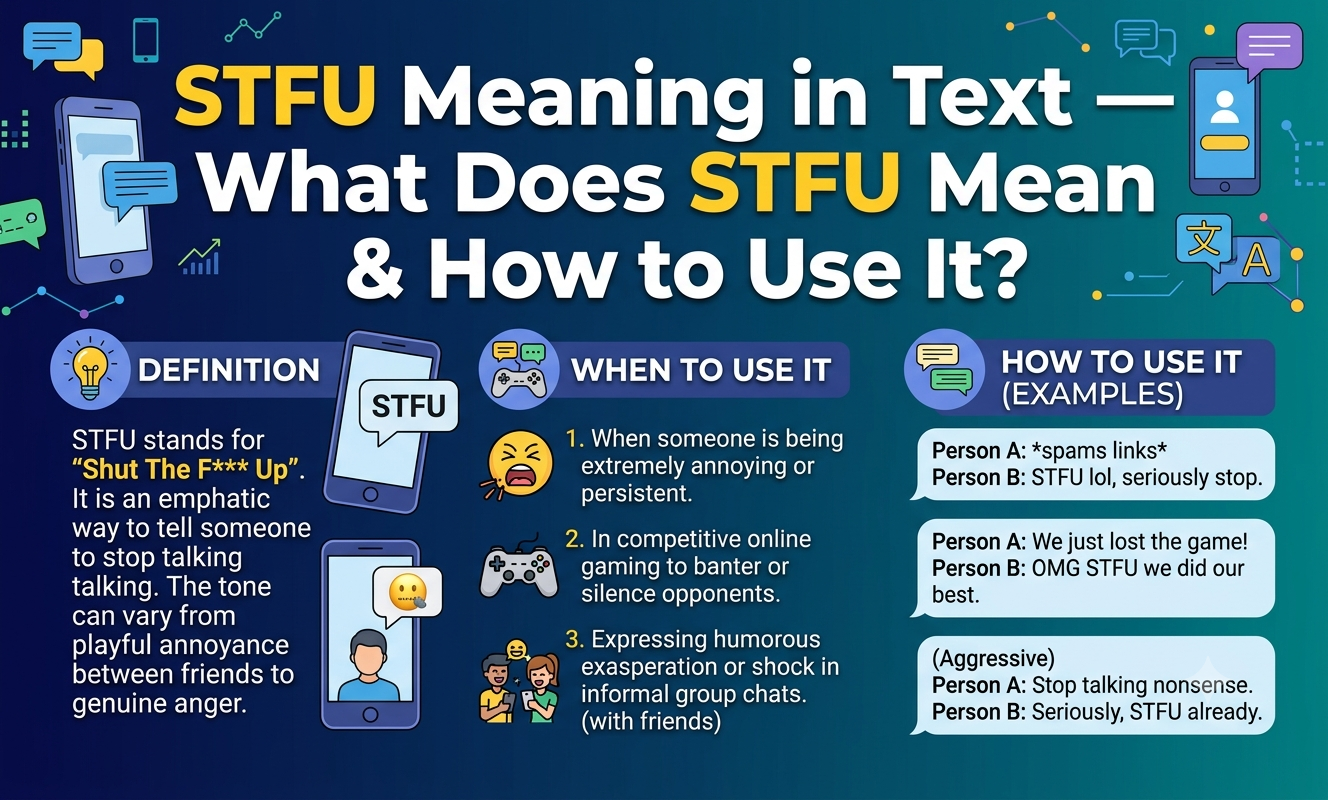
Quick Answer: STFU stands for “Shut The F*** Up.” It’s an internet slang abbreviation used in texting and social media to tell someone — often bluntly or jokingly — to stop talking. It can be playful between close friends or genuinely rude depending on tone and context.
So, Your Kid (Or Friend) Just Texted You “STFU” — Now What?
Picture this: you’re in a group chat, someone drops a wild joke, and the next reply is just “STFU 😂.” Are they mad? Are they laughing? This is exactly why the stfu meaning in text confuses so many people, especially parents scrolling through their teen’s phone for the first time.
Here’s the short version: stfu meaning in text almost always refers to the phrase “Shut The F*** Up.” But how it’s used matters way more than what it stands for. In this guide, you’ll learn where the term came from, how to use it (or avoid it), how it shows up differently across WhatsApp, Snapchat, TikTok, and Instagram in 2026, and how to reply if someone sends it to you.
What Does STFU Mean?
STFU is a texting abbreviation that stands for “Shut The F* Up.”** It’s a blunt, often profane way of telling someone to stop talking, stop texting, or stop bringing up a topic.
The phrase itself has existed in spoken English for decades, but the acronym form exploded once texting and instant messaging became mainstream in the early 2000s. As character limits and fast typing became the norm, users shortened common phrases into quick, punchy acronyms — and STFU became one of the most recognizable.
By 2026, STFU has fully crossed over from private texting into public internet culture. It shows up in comment sections, gaming voice chats, meme captions, and reaction videos. Language trend trackers who study Gen Z and Gen Alpha slang note that STFU is now used more often as an expression of shock or excitement than as genuine anger — similar to how “shut up” is casually used in spoken conversation when someone hears surprising news.
STFU Full Form Explained
Since STFU is an acronym, here’s exactly what each letter stands for:
| Letter | Stands For |
|---|---|
| S | Shut |
| T | The |
| F | F*** |
| U | Up |
Full form: Shut The F*** Up
It’s worth noting that because the “F” represents a swear word, STFU is generally considered informal and mildly-to-moderately vulgar, even though it’s extremely common in casual digital conversation.
How to Use STFU — Real Examples
The tone of STFU changes completely depending on who’s saying it, to whom, and why. Below are common real-world situations showing how it’s actually used in 2026 texting culture.
| Situation | Example | Emotion |
|---|---|---|
| Hearing shocking gossip | “Wait, they broke up?? STFU, no way.” | Shock/disbelief |
| Friend brags about good news | “I got the internship!!” “STFU, congrats!!” | Excitement/happiness |
| Someone won’t stop teasing | “STFU, that’s not even funny.” | Mild annoyance |
| Reacting to a plot twist in a show | “The ending made no sense, STFU.” | Frustrated amusement |
| Genuine argument | “STFU, you don’t know what you’re talking about.” | Anger |
| Sibling being annoying | “Mom said I’m the favorite.” “STFU 🙄” | Playful irritation |
| Friend shares a funny meme | “STFU this is literally me.” | Amused agreement |
| Someone spoils a movie | “So the main character actually dies—” “STFU DO NOT FINISH THAT SENTENCE.” | Panic/humor |
| Compliment overload | “You’re actually so talented.” “Stfu, stop 😳” | Flattered embarrassment |
| Online gaming loss | “STFU how did you even hit that shot” | Competitive frustration |
Notice how in most of these, STFU isn’t really about silencing someone — it’s an emotional reaction, much like saying “no way” or “shut up, seriously?” out loud.
STFU on Different Platforms (2026)
Usage of STFU varies slightly depending on the app, audience, and format. Here’s how it typically shows up across major platforms this year.
On WhatsApp
WhatsApp remains the go-to app for close friend groups and family chats, especially outside the U.S. On WhatsApp, STFU tends to appear in private one-on-one or small group chats, usually among people who already know each other well. It’s often paired with laughing emojis to soften the tone.
On Snapchat
Snapchat’s fast, disappearing-message culture makes STFU common as a quick reaction to Snap stories or chats — especially reacting to gossip, relationship updates, or embarrassing photos. Because messages vanish, users tend to be more casual and less filtered here.
On TikTok
On TikTok, STFU frequently appears in comment sections reacting to surprising videos, plot twists, or relatable content. It’s also common in captions like “STFU this trend is everywhere” — used more as an exclamation of disbelief than an insult.
On Instagram
On Instagram, especially in DMs and comments on Reels, STFU is used similarly to TikTok — as a reaction to funny or shocking content. It also shows up in caption text under photos when friends are joking around in the comments.
Across all platforms in 2026, moderation systems and platform guidelines have gotten stricter about profanity-adjacent language, so many users now default to the abbreviation instead of writing it out fully, partly to avoid automated content flags.
Is STFU Rude or Offensive?
This depends entirely on context, relationship, and tone.
When it’s generally fine:
- Between close friends who joke around this way regularly
- Used as a reaction to funny or surprising news
- Sent with laughing emojis or all lowercase, casual tone
When it can be genuinely rude or hurtful:
- Sent to someone you don’t know well
- Used during a real argument or disagreement
- Sent by a child or teen to a parent, teacher, or authority figure
- Used to shut down someone who is trying to express real feelings
For parents specifically: seeing STFU in your teen’s messages doesn’t automatically mean something is wrong. Context is everything — a message like “STFU that’s insane 😭” between friends reacting to news is very different from someone using it to shut down a serious conversation.
How to Reply to STFU
If someone sends you STFU, your reply should match the tone they used. Here are common ways people respond:
| Their Tone | Your Reply Example | Why It Works |
|---|---|---|
| Joking/excited | “Right?? I couldn’t believe it either 😂” | Matches their energy |
| Sarcastic tease | “Lol okay okay, moving on” | De-escalates playfully |
| Genuinely annoyed | “Sorry, I didn’t mean to upset you” | Shows you’re taking it seriously |
| Angry/hostile | “Let’s talk about this calmly” | Sets a boundary without escalating |
| Used on you unfairly | “That’s not okay, I was just talking” | Stands up for yourself respectfully |
| Confused why they said it | “Wait why, what happened?” | Asks for clarification |
If STFU is used repeatedly to shut down real conversations or feels disrespectful, it’s okay to say directly that the language makes you uncomfortable and ask them to communicate differently.
STFU Alternatives and Similar Slang
STFU belongs to a bigger family of texting acronyms. Here are similar terms you’ll likely run into in 2026 conversations:
| Term | Meaning |
|---|---|
| GTFO | Get The F*** Out |
| IDGAF | I Don’t Give A F*** |
| SMH | Shaking My Head |
| TBH | To Be Honest |
| NGL | Not Gonna Lie |
| ISTG | I Swear To God |
| FR FR | For Real, For Real |
| STG | Swear To God |
These terms often appear together in the same conversations, especially when reacting to surprising or dramatic news.
Frequently Asked Questions (FAQ)
Q: What does STFU mean in a text message? A: STFU means “Shut The F*** Up.” It’s typically used to react to shocking, funny, or annoying situations rather than as a literal command to stop talking.
Q: Is STFU a bad word? A: STFU is an abbreviation that includes a swear word, so it’s considered mildly to moderately vulgar. It’s generally acceptable in casual conversations between friends but inappropriate in formal or respectful contexts.
Q: Is it rude to say STFU to someone? A: It depends on the relationship and tone. Among close friends joking around, it’s usually harmless. Used during an argument or toward someone you don’t know well, it can come across as disrespectful.
Q: What’s the difference between STFU and STFU FR? A: “STFU FR” adds “for real,” emphasizing genuine shock or agreement, similar to saying “no way, seriously?”
Q: Should parents be worried if they see STFU in their teen’s texts? A: Not necessarily. In most cases, STFU is used casually among friends to react to surprising or funny news rather than as an aggressive statement. Context and tone matter more than the word itself.
Q: What does STFU mean on TikTok or Instagram comments? A: On these platforms, STFU is usually used as an exclamation of disbelief or amusement in reaction to a video, post, or comment — not as a genuine command.
Wrapping It Up
Understanding the stfu meaning in text really comes down to reading the room. While it technically stands for “Shut The F*** Up,” in most 2026 conversations it’s used as a casual reaction to shock, humor, or excitement rather than a genuine insult. Context, tone, and relationship always matter more than the letters themselves.
Whether you’re a teen decoding group chat slang or a parent trying to keep up, knowing how terms like this actually get used online makes everyday texting a lot less confusing. Bookmark this page next time a confusing acronym pops up in your messages.
Also read FOMO Meaning in Text — What Does FOMO Mean & How to Use It?
