
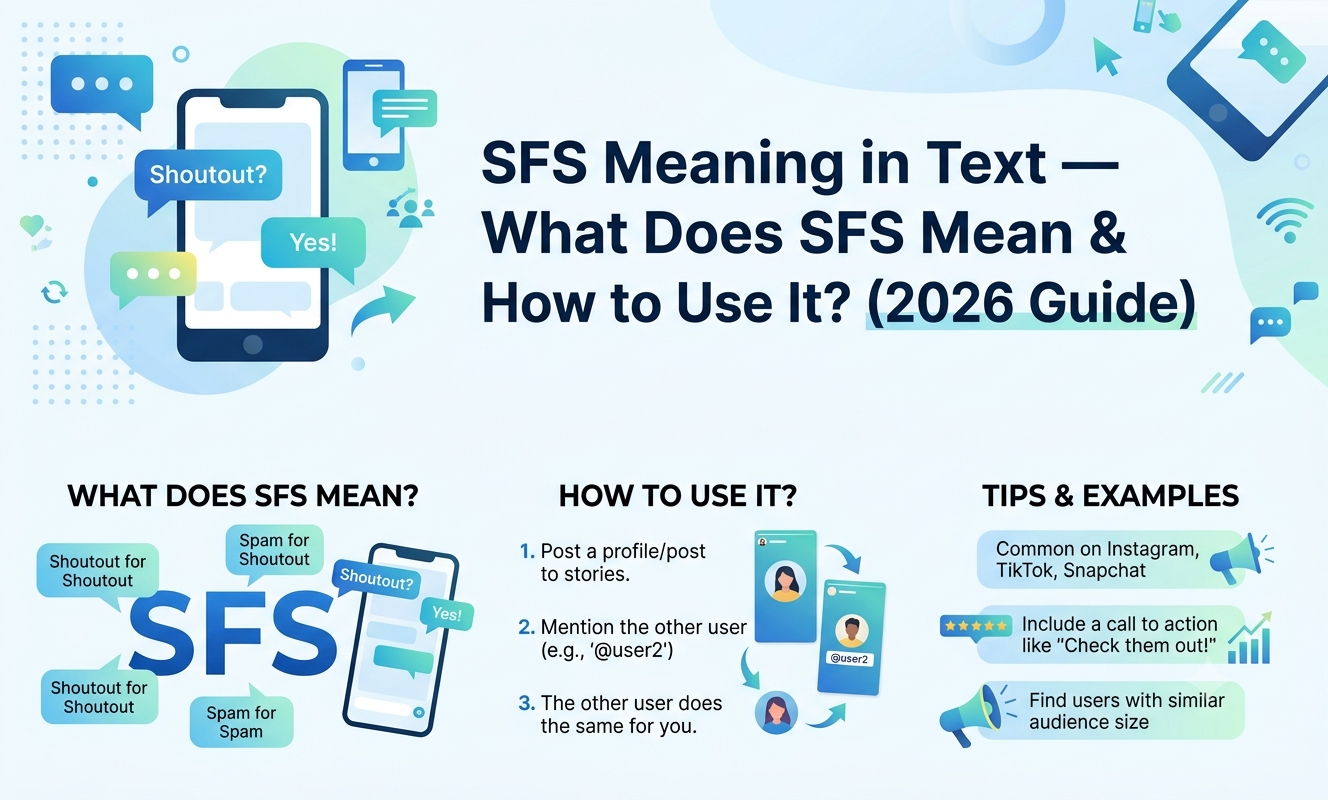
Quick Answer: SFS stands for “Shoutout for Shoutout.” It’s a texting and social media term used when someone asks another person to promote or feature them in return for doing the same. It’s most common on Instagram and Snapchat, especially among teens and small creators trying to grow their following.
Introduction
Ever seen “SFS?” pop up in your DMs or a comment section and had no idea what it meant? You’re not alone. If your kid, friend, or follower sent you this abbreviation, they weren’t speaking in code to confuse you — SFS meaning in text is simply a quick way of asking for a mutual shoutout.
This term has become a regular part of how teens and young creators communicate online, especially when they want more followers or engagement without spending money on ads. In this guide, you’ll learn exactly what SFS means, where it came from, how it’s used across WhatsApp, Snapchat, TikTok, and Instagram in 2026, whether it can come across as rude, and how to reply if someone sends it to you. We’ll also cover similar slang terms so you’re never caught off guard again.
What Does SFS Mean?
SFS stands for “Shoutout for Shoutout.” It’s an informal request between two people or accounts to promote each other. Person A posts something nice about Person B (a shoutout), and in return, Person B does the same for Person A.
The term grew out of early Instagram and Twitter culture, back when creators realized that tagging and recommending each other’s pages was one of the easiest ways to gain followers without paying for ads. By the mid-2020s, SFS had firmly settled into everyday teen texting vocabulary, no longer limited to influencers — regular users now use it casually among friend groups too.
In 2026, SFS is less about big influencer trades and more about small, everyday exchanges: a teen asking a classmate for a shoutout on their new account, a small business page trading a mention with another small page, or friends simply hyping each other up publicly. The core idea — mutual promotion — hasn’t changed, but the scale has become much more personal and casual.
SFS Full Form Explained
Since SFS is an acronym, here’s what each letter stands for:
| Letter | Stands For | Meaning |
|---|---|---|
| S | Shoutout | A public mention, post, or story tagging someone |
| F | For | Indicates exchange or mutual action |
| S | Shoutout | The other person doing the same thing back |
In short, SFS = Shoutout For Shoutout — a simple “you promote me, I’ll promote you” arrangement.
It’s worth noting that SFS is sometimes confused with other similar-looking acronyms like “F4F” (Follow for Follow) or “L4L” (Like for Like). While they belong to the same family of “mutual exchange” slang, SFS is specifically about shoutouts — meaning a post, story, or comment that mentions or promotes the other person, not just a follow or a like.
How to Use SFS — Real Examples
SFS can show up in casual texts, Instagram/Snapchat captions, comments, or DM requests. Here are real-world examples across different emotional contexts:
| Situation | Example | Emotion |
|---|---|---|
| Asking a friend for a shoutout | “Can we do an SFS? I just made a new page 🙏” | Hopeful |
| Offering one first | “I’ll SFS you if you SFS me back!” | Friendly |
| Excited after a trade | “Just did an SFS with @sarahh and my followers went up so fast!!” | Excited |
| Casual, low-pressure ask | “no pressure but SFS? 👀” | Playful |
| Business page reaching out | “Love your content! Wanna do an SFS to support each other’s small pages?” | Professional/polite |
| Declining politely | “Aw I appreciate it but I don’t really do SFS anymore, sorry!” | Apologetic |
| Frustrated after being ignored | “I did your SFS and you never posted mine 😒” | Annoyed |
| Grateful response | “Thank you so much for the SFS, means a lot!!” | Grateful |
| Group chat request | “Anyone tryna SFS for our team page?” | Neutral/casual |
| Confused reaction | “wait what does SFS even mean lol” | Confused |
Notice how the tone shifts depending on context — SFS can be exciting, casual, professional, or even a source of mild frustration if one side doesn’t follow through.
SFS on Different Platforms (2026)
The way SFS gets used differs slightly depending on which app you’re on. Here’s how it plays out across the major platforms this year.
On WhatsApp
WhatsApp isn’t a discovery-based platform like Instagram or TikTok, so SFS shows up less often here — but it still appears in group chats, especially among students promoting a class page, event, or small side project. On WhatsApp, SFS is usually a quick text between friends rather than a public post, since WhatsApp doesn’t have a public feed for shoutouts.
On Snapchat
Snapchat has long been one of the more common places for SFS requests, often through Snap Stories. Users post a screenshot or Snap tagging another account and asking followers to check them out. In 2026, Snapchat’s Stories and Spotlight features continue to make SFS a natural fit, since a Story shoutout disappears after 24 hours, making it feel low-effort and low-commitment for both sides.
On TikTok
On TikTok, SFS has evolved into short collab-style videos or “shoutout” duets rather than plain text captions. Instead of a simple written SFS, creators often film a quick clip introducing the other person’s account. TikTok’s algorithm-driven discovery means that even a single well-placed shoutout video can meaningfully boost a smaller account, which is part of why SFS trades remain popular among micro-creators trying to grow in 2026.
On Instagram
Instagram remains the home base of SFS culture. It shows up in Stories, captions, and comment sections, often paired with a tagged photo or repost. Instagram’s Stories “mention” sticker makes it especially easy to do a quick SFS by tagging someone directly in a Story that disappears after a day — low effort, but still visible to your whole following list.
Is SFS Rude or Offensive?
SFS itself is not rude or offensive — it’s a neutral, casual term used for mutual promotion. However, context matters:
- Friendly context: Between friends or peer creators, SFS is simply a fun, supportive way to help each other grow. No harm intended.
- Spammy context: If someone repeatedly DMs strangers with “SFS?” out of nowhere, without any real relationship or shared interest, it can come across as spammy or transactional rather than genuine.
- Broken-promise context: SFS can feel disrespectful if one person does the shoutout and the other never follows through — this is often where frustration or hurt feelings show up, as seen in the example table above.
So while the term itself isn’t offensive, how and when it’s used can shape whether it feels friendly or annoying.
How to Reply to SFS
If someone sends you an SFS request, here are some simple, natural ways to respond depending on your comfort level:
| Their Message | Your Reply | Tone |
|---|---|---|
| “Can we do an SFS?” | “Sure! Send me your page and I’ll post it 😊” | Agreeable |
| “SFS?” | “I don’t really do SFS but thanks for asking!” | Polite decline |
| “Wanna SFS each other?” | “Let’s do it! I’ll post you in my next story” | Enthusiastic |
| “Can you SFS my new account?” | “Of course, just tag me back when you post yours” | Cooperative |
| “SFS pls 🙏” | “Not right now, but good luck growing your page!” | Kind but firm |
| “I did your SFS, did you see?” | “Yes! Just posted yours too, thank you!” | Appreciative |
SFS Alternatives and Similar Slang
SFS belongs to a wider family of “mutual exchange” internet slang. Here are some similar terms you might come across:
| Term | Full Meaning |
|---|---|
| F4F | Follow for Follow |
| L4L | Like for Like |
| C4C | Comment for Comment |
| S4S | Same as SFS (Shoutout for Shoutout, alternate spelling) |
| R4R | Repost for Repost |
| CB | Comeback (respond after being tagged) |
| TFS | Thanks for Support/Shoutout |
| Collab | Short for collaboration, often includes an SFS-style trade |
Knowing these related terms makes it much easier to understand the broader “growth exchange” language used across social platforms in 2026.
Frequently Asked Questions (FAQ)
Q: What does SFS mean in text from a girl or guy? A: The meaning doesn’t change based on gender — SFS simply means “Shoutout for Shoutout,” a request to promote each other’s pages or posts.
Q: Is SFS the same as F4F? A: No. SFS refers specifically to shoutouts (a post or mention promoting someone), while F4F refers to simply following someone back. They’re similar in spirit but not identical.
Q: What does SFS mean on Snapchat specifically? A: On Snapchat, SFS usually means someone wants a shoutout posted in your Story, tagging their account so your friends can check them out.
Q: Why do people use SFS instead of asking directly? A: SFS is just a shorthand — it’s faster to type and instantly recognizable to anyone familiar with social media slang, so it’s become the default way to ask.
Q: Is it okay to ignore an SFS request? A: Yes, completely. SFS requests are casual and optional. You’re never obligated to do a shoutout just because someone asked.
Q: Does SFS still work for growing an Instagram or TikTok account in 2026? A: It can help in a small way, especially between accounts with a similar audience size, but algorithm-based discovery (like TikTok’s For You Page) tends to have a much bigger impact on growth than SFS trades alone.
Conclusion
SFS meaning in text comes down to one simple idea: Shoutout for Shoutout — a casual, mutual way of promoting each other on social media. Whether it shows up in a WhatsApp group chat, a Snapchat Story, a TikTok video, or an Instagram comment, the intent stays the same — help each other get seen.
Now that you know what it means, where it came from, and how to use or reply to it, you’ll never be confused by an “SFS?” text again. Bookmark this page so you always have a quick reference for SFS and other texting slang whenever it pops up in your DMs.
Also read ATM Meaning in Text — What Does ATM Mean & How to Use It?
