
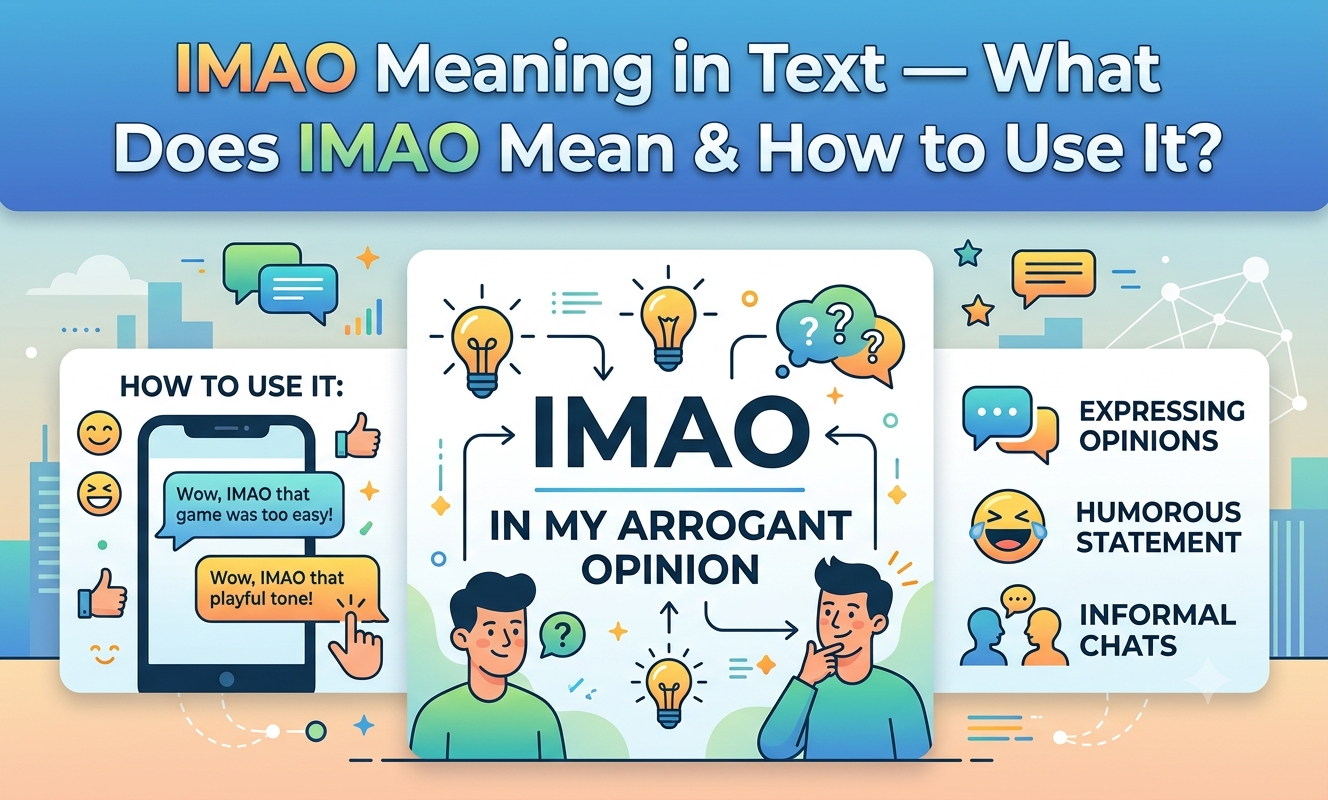
Quick Answer: IMAO stands for “In My Arrogant Opinion.” It’s a sarcastic, joking version of IMO (In My Opinion), used when someone wants to sound confident, cocky, or funny while sharing a thought. It’s almost never meant to be taken seriously.
Introduction
Ever seen a text end with “IMAO, pineapple belongs on pizza” and wondered what it actually means? You’re not alone. Thousands of people search for IMAO meaning in text every month because it looks like a typo of the more common IMO or IMHO.
But IMAO isn’t a mistake — it’s its own thing. In this article, you’ll learn exactly what IMAO stands for, where it came from, how to use it in real conversations, and how it’s used differently across WhatsApp, Snapchat, TikTok, and Instagram in 2026. We’ll also cover whether it can come across as rude, how to reply to it, and similar slang terms you should know.
By the end, you’ll be able to spot IMAO in any chat and use it confidently yourself.
What Does IMAO Mean?
IMAO stands for “In My Arrogant Opinion.” It’s a playful twist on the much older abbreviation IMO (“In My Opinion”) and IMHO (“In My Humble Opinion”). Instead of sounding humble, IMAO flips the tone on purpose — the person is joking about being overly confident or a bit of a know-it-all.
It’s almost always used with humor or sarcasm. Nobody actually thinks they’re “arrogant” when they type it — they’re poking fun at themselves (or gently teasing the person they’re talking to) while still sharing a genuine opinion.
Origin and background: IMAO grew out of early internet forums and instant messaging culture in the late 1990s and 2000s, alongside other opinion-abbreviations like IMO and IMHO. It never became as mainstream as those two, but it has stuck around in casual texting, gaming chats, and group chats as a niche, slightly cheeky alternative.
In 2026, IMAO has seen a small resurgence thanks to Gen Z’s love of ironic, self-aware language — the same trend that brought back terms like “delulu” and “no cap.” Teens often use it sarcastically to sound dramatic about small, unimportant opinions (like debating the best pizza topping).
IMAO Full Form Explained
IMAO is an acronym, and each letter stands for a specific word. Here’s the breakdown:
| Letter | Stands For |
|---|---|
| I | In |
| M | My |
| A | Arrogant |
| O | Opinion |
So the full form is: In My Arrogant Opinion.
It’s important not to confuse this with similar-looking abbreviations:
| Acronym | Full Form | Tone |
|---|---|---|
| IMO | In My Opinion | Neutral |
| IMHO | In My Humble Opinion | Polite, modest |
| IMAO | In My Arrogant Opinion | Sarcastic, joking |
| LMAO | Laughing My A** Off | Laughter/humor |
Note: IMAO is sometimes mistyped for LMAO, but they mean completely different things — always check the context of the sentence.
How to Use IMAO — Real Examples
IMAO works best when you want to sound funny, dramatic, or playfully overconfident about a fairly harmless opinion. Below are real examples across different emotional contexts.
| Situation | Example | Emotion |
|---|---|---|
| Debating food | “IMAO, pineapple on pizza is actually elite.” | Playful/Sarcastic |
| Movie opinions | “IMAO the book was way better than the movie.” | Confident/Joking |
| Fashion talk | “IMAO oversized hoodies just look better than fitted ones.” | Cocky/Funny |
| Music debate | “IMAO this album is the best one they’ve dropped.” | Passionate |
| Sports banter | “IMAO that ref made the worst call of the season.” | Frustrated/Humorous |
| Gaming chat | “IMAO I carried that whole match.” | Boastful/Joking |
| School debate | “IMAO group projects should be banned forever.” | Sarcastic |
| Friendly argument | “IMAO you’re wrong but it’s fine, I still love you.” | Teasing |
| Pop culture take | “IMAO that show got worse after season 2.” | Opinionated |
| Everyday chat | “IMAO Mondays should be illegal.” | Lighthearted |
Notice how none of these are meant to start real fights — the “arrogant” part is the joke itself.
IMAO on Different Platforms (2026)
How IMAO is used can shift slightly depending on where you’re texting. Here’s how it shows up in 2026 across the biggest chat platforms.
On WhatsApp
WhatsApp remains the top choice for group chats among friends and family, and IMAO shows up mostly in casual group debates — sports groups, friend circles, and family banter threads. Because WhatsApp conversations tend to run longer and more personal, IMAO is often followed by a laughing emoji to make the sarcasm crystal clear.
On Snapchat
On Snapchat, where messages disappear and tone can be harder to read, IMAO is usually paired with a Bitmoji reaction or a quick voice note to avoid being misread as actual arrogance. Snap’s short-form, fast-paced chat style favors quick acronyms like IMAO over full sentences.
On TikTok
In TikTok comment sections, IMAO has become a popular way to jokingly “win” an argument in the comments — for example, replying to a debate video with “IMAO this is objectively correct.” It’s part of the platform’s larger trend of exaggerated, confident-sounding comment humor in 2026.
On Instagram
On Instagram, IMAO tends to appear in captions or comment replies when someone wants to sound playfully bold about a post — think fashion posts, food pics, or opinion-based Reels. It fits Instagram’s more curated, performative style of humor.
2026 Trend Note: Across all platforms, Gen Z’s love of ironic overconfidence (paired with self-deprecating humor) has kept niche acronyms like IMAO alive, even as newer slang terms continue to emerge.
Is IMAO Rude or Offensive?
IMAO is not inherently rude or offensive — but context matters.
Why it’s usually harmless:
- It’s self-aware sarcasm. The person is joking about sounding arrogant, not actually being rude.
- It’s typically used for low-stakes topics like food, movies, or games.
- Most people who use or receive it understand the joke instantly.
When it could come across poorly:
- If used in a serious or sensitive conversation, it might seem dismissive of the other person’s feelings.
- Without emojis or familiar context, someone unfamiliar with the term might misread it as genuinely arrogant.
- Using it repeatedly in a debate could make it feel like you’re not taking the other person’s opinion seriously.
Bottom line: Among friends in casual chats, IMAO is playful. In formal, professional, or emotionally serious conversations, it’s best avoided.
How to Reply to IMAO
Not sure how to respond when someone drops an IMAO on you? Here are a few solid options depending on the vibe.
| Their Message | Your Reply | Tone |
|---|---|---|
| “IMAO, this show is overrated.” | “Lol agree to disagree.” | Playful |
| “IMAO pizza with pineapple is fire.” | “IMAO you’re wrong but okay 😂” | Teasing back |
| “IMAO I could’ve won that game solo.” | “Sure buddy 😂” | Sarcastic |
| “IMAO Mondays are the worst.” | “Facts, no argument here.” | Agreeing |
| “IMAO this band > every other band.” | “That’s a bold take lol.” | Light challenge |
| “IMAO you should’ve listened to me.” | “Okay fair, you were right this time.” | Good-humored |
IMAO Alternatives and Similar Slang
If you want to mix things up, here are other opinion-related acronyms and slang terms with similar or related meanings.
| Term | Meaning |
|---|---|
| IMO | In My Opinion |
| IMHO | In My Humble Opinion |
| TBH | To Be Honest |
| NGL | Not Gonna Lie |
| FR | For Real |
| No Cap | Not lying / being serious |
| Facts | Agreeing strongly with a statement |
| LMAO | Laughing My A** Off (different meaning, often confused) |
Frequently Asked Questions (FAQ)
Q: What does IMAO mean in text? A: IMAO means “In My Arrogant Opinion.” It’s a joking, sarcastic way of sharing an opinion while pretending to sound overconfident.
Q: Is IMAO the same as LMAO? A: No. IMAO means “In My Arrogant Opinion,” while LMAO means “Laughing My A** Off.” They’re spelled similarly but mean completely different things.
Q: Is IMAO rude to use? A: Not usually. It’s meant as a joke, especially with friends. It can seem dismissive only if used in a serious or sensitive conversation.
Q: What’s the difference between IMO, IMHO, and IMAO? A: IMO is neutral (“In My Opinion”), IMHO is modest (“In My Humble Opinion”), and IMAO is sarcastic (“In My Arrogant Opinion”), used for humor rather than genuine arrogance.
Q: Where is IMAO most commonly used in 2026? A: IMAO shows up most in casual chats on WhatsApp, TikTok comments, Snapchat messages, and Instagram captions, usually among younger users who enjoy ironic, confident-sounding humor.
Q: Can IMAO be used in professional or formal texts? A: It’s best to avoid it in professional settings, since sarcasm doesn’t always translate well in formal or unfamiliar conversations.
Conclusion
IMAO is a small but fun piece of internet slang that means “In My Arrogant Opinion” — a sarcastic, joking twist on the more familiar IMO and IMHO. It’s mostly used for harmless debates about food, movies, music, or games, and it’s rarely meant to actually offend anyone.
Now that you know the IMAO meaning in text, how it’s used across WhatsApp, Snapchat, TikTok, and Instagram, and how to reply to it, you’ll never be confused by it again. Bookmark this page so you can quickly check IMAO or any other confusing text slang whenever it pops up in your chats.
Also read PU Meaning in Text — What Does PU Mean & How to Use It?
