
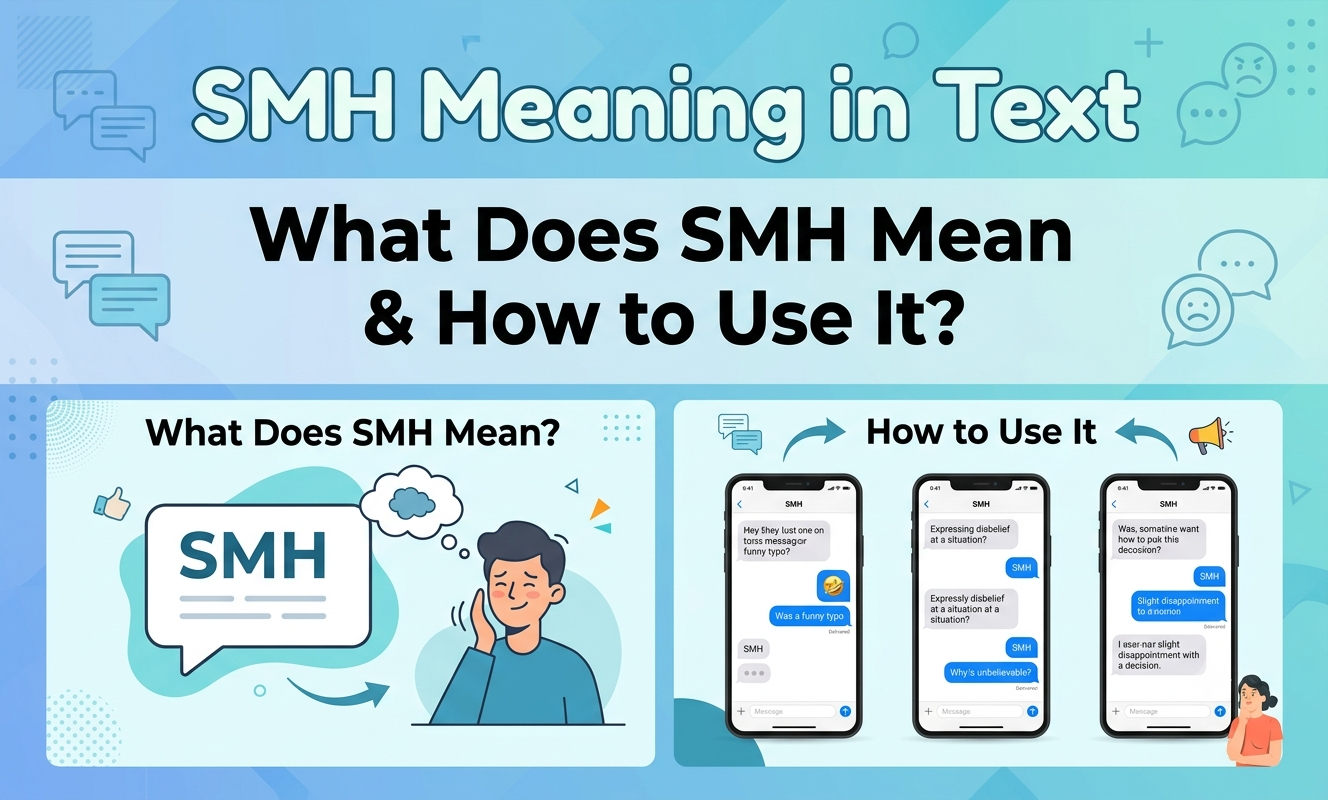
Quick Answer: SMH stands for “Shaking My Head.” It’s used to express disappointment, disbelief, frustration, or mild embarrassment about something someone said or did. It can be serious (“smh, that’s so unfair”) or playful and sarcastic (“smh you again”), depending on the tone of the conversation.
Introduction
Ever read a text that just said “smh” and wondered what your friend, sibling, or coworker actually meant? You’re not alone. SMH meaning in text trips up a lot of people, especially parents trying to keep up with how their kids text.
In short, SMH means “shaking my head” — a quick way to show disapproval, disappointment, or disbelief without typing out a whole sentence. It’s one of those texting abbreviations that’s been around for years but keeps evolving with new platforms and new contexts.
In this article, you’ll learn exactly what SMH means, where it came from, how to use it correctly in different situations, how people use it on WhatsApp, Snapchat, TikTok, and Instagram, whether it’s considered rude, and how to reply when someone sends it to you. We’ve also included example tables so you can see it in action.
What Does SMH Mean?
SMH is a texting abbreviation for “Shaking My Head.” It’s a physical gesture turned into text shorthand — the same head-shake you’d give in real life when something disappoints you, surprises you, or just doesn’t make sense.
The phrase has roots in early internet forums and instant messaging culture from the 2000s, where short abbreviations like LOL, BRB, and OMG were becoming the norm. SMH followed a similar path: it started as a way to save time typing and became a standalone way to express an emotion.
By the time texting and social media matured, SMH had become one of the most recognizable pieces of internet slang. Heading into 2026, SMH remains extremely common across messaging apps and comment sections, largely because it works in almost any tone — sarcastic, serious, sympathetic, or annoyed — making it flexible enough to survive newer slang trends that come and go much faster.
Unlike some slang that fades after a year or two, SMH has stayed relevant because it fills a gap: there isn’t really a single-word replacement for “I’m disappointed/annoyed/surprised by this, but I don’t want to write a paragraph about it.”
SMH Full Form Explained
SMH is an acronym, and each letter stands for a specific word.
| Letter | Stands For |
|---|---|
| S | Shaking |
| M | My |
| H | Head |
Put together, S-M-H = “Shaking My Head.” Some people also use lowercase “smh,” which is the more common casual form in texting, while SMH in all caps is sometimes used for emphasis.
How to Use SMH — Real Examples
SMH can shift meaning slightly depending on tone, punctuation, and context. Here are examples across different emotional situations.
| Situation | Example | Emotion |
|---|---|---|
| Friend cancels plans last minute | “You’re bailing again? smh” | Mild annoyance |
| Someone shares bad news about the world | “They raised prices again, smh” | Disappointment |
| A funny fail video | “He tripped over his own dog lol smh” | Playful/amused |
| Sibling forgets something important | “You forgot my birthday… smh” | Hurt/disappointed |
| Watching a bad decision in a show | “Why would she do that, smh” | Disbelief |
| Coworker misses a deadline | “Still no report from him, smh” | Frustration |
| Reacting to a silly meme | “smh this is too accurate” | Humor |
| Someone brags too much | “He’s at it again, smh” | Mild judgment |
| A friend makes an obvious mistake | “You left your keys in the door again, smh” | Affectionate teasing |
| Reacting to unfair treatment | “They didn’t even apologize, smh” | Frustration/sadness |
Notice how the same three letters can carry very different weight — from lighthearted teasing between friends to genuine frustration about a serious situation. Context and relationship matter more than the letters themselves.
SMH on Different Platforms (2026)
The way SMH is used can vary slightly depending on the platform, since each app has its own texting culture, response speed, and audience.
On WhatsApp
WhatsApp remains one of the most text-heavy messaging apps, especially for family group chats and one-on-one conversations. On WhatsApp, SMH tends to appear in longer, more conversational messages — often paired with a full sentence rather than standing alone. It’s common to see it used by both teens and parents, since WhatsApp has a broad, multi-generational user base.
On Snapchat
Snapchat conversations are usually short and fast-paced, so SMH often appears on its own, sometimes paired with an emoji instead of extra words. Because Snapchat leans toward casual, in-the-moment reactions, SMH here is frequently more playful than serious.
On TikTok
In TikTok comment sections, SMH is used heavily to react to videos — both funny and frustrating ones. It’s common to see it stacked with other reaction abbreviations or emojis, such as “smh 💀” for something that’s both disappointing and funny at the same time. TikTok’s comment culture has helped keep SMH relevant among younger users heading into 2026, since short, punchy reactions perform well in fast-scrolling feeds.
On Instagram
On Instagram, SMH shows up most often in comments and captions reacting to posts, reels, or stories. It’s frequently used sarcastically in caption text under a post about a relatable frustration (e.g., a caption reading “Monday again, smh”). Instagram’s mix of casual posts and more polished content means SMH appears in both funny and genuinely frustrated contexts.
Is SMH Rude or Offensive?
SMH is generally not considered offensive, but it can come across as rude depending on the context and who’s on the receiving end.
When it’s not rude:
- Used between friends as light teasing
- Reacting to a funny or relatable situation
- Used to express general disappointment about news, weather, or everyday annoyances
When it can feel rude:
- Used in response to someone sharing something personal or vulnerable
- Sent in a professional or formal setting
- Used dismissively when someone is trying to explain themselves
The key is tone and relationship. Between close friends, SMH is usually harmless. In a professional email or a serious conversation, sending “smh” can come across as dismissive or condescending, since it doesn’t leave room for explanation. When in doubt, it’s safer to use SMH with people you know well rather than in formal or sensitive conversations.
How to Reply to SMH
If someone sends you “smh,” how you respond depends on why they sent it. Here are some example replies for different situations.
| Their Message | Your Reply | Tone |
|---|---|---|
| “smh you’re late again” | “I know, I know, sorry!” | Apologetic |
| “smh this weather” | “Right? It’s been awful” | Agreeing |
| “smh why would he say that” | “Seriously, that was uncalled for” | Supportive |
| “smh” (with no context) | “What happened?” | Curious |
| “smh you always do this” | “Okay that’s fair, my bad” | Accountable |
| “smh 😂” (reacting to a joke) | “lol I know, too accurate” | Playful |
SMH Alternatives and Similar Slang
If you want to mix up your texting vocabulary, here are similar abbreviations that carry comparable meanings.
| Slang | Full Meaning | When to Use |
|---|---|---|
| FR | For Real | Emphasizing sincerity or agreement |
| NGL | Not Gonna Lie | Sharing an honest opinion |
| SMDH | Shaking My Damn Head | A more intense version of SMH |
| IKR | I Know, Right | Agreeing with frustration or surprise |
| TBH | To Be Honest | Prefacing an honest reaction |
| YIKES | — | Reacting to something awkward or bad |
| BRUH | — | Expressing disbelief or annoyance |
| WOW | — | Reacting to something surprising, often sarcastically |
Frequently Asked Questions (FAQ)
Q: What does SMH mean in a text message? A: SMH means “Shaking My Head.” It’s used to show disappointment, disbelief, or frustration about something.
Q: Is SMH always negative? A: Not always. While SMH often expresses disappointment or frustration, it can also be used playfully among friends to react to something funny or relatable.
Q: Can SMH be used in professional settings? A: It’s best to avoid SMH in formal emails or workplace messages, since it can come across as dismissive. It’s more appropriate for casual texting with friends or family.
Q: What’s the difference between SMH and SMDH? A: SMDH stands for “Shaking My Damn Head,” which is a stronger, more emphatic version of SMH, usually used when someone is more frustrated than usual.
Q: Do older generations understand SMH texting slang? A: Many parents and older adults are now familiar with SMH, since it has been widely used across messaging apps and social media for years, making it one of the more universally understood texting abbreviations.
Q: Is SMH used the same way on every platform? A: The core meaning stays the same everywhere, but tone can shift slightly — for example, TikTok and Snapchat tend to use it more playfully, while WhatsApp messages often pair it with fuller sentences.
Conclusion
SMH is a simple but versatile piece of texting slang that means “Shaking My Head,” used to express everything from mild disappointment to playful teasing. Its meaning depends heavily on context, tone, and the platform you’re using — whether that’s a WhatsApp family chat or a TikTok comment section.
Now that you know what SMH means, how to use it, and how to reply to it, you’ll never be confused by it in a text again. Bookmark this page next time you come across a texting abbreviation that leaves you scratching your head.
Also read ASL Meaning in Text — What Does ASL Mean & How to Use It?
