
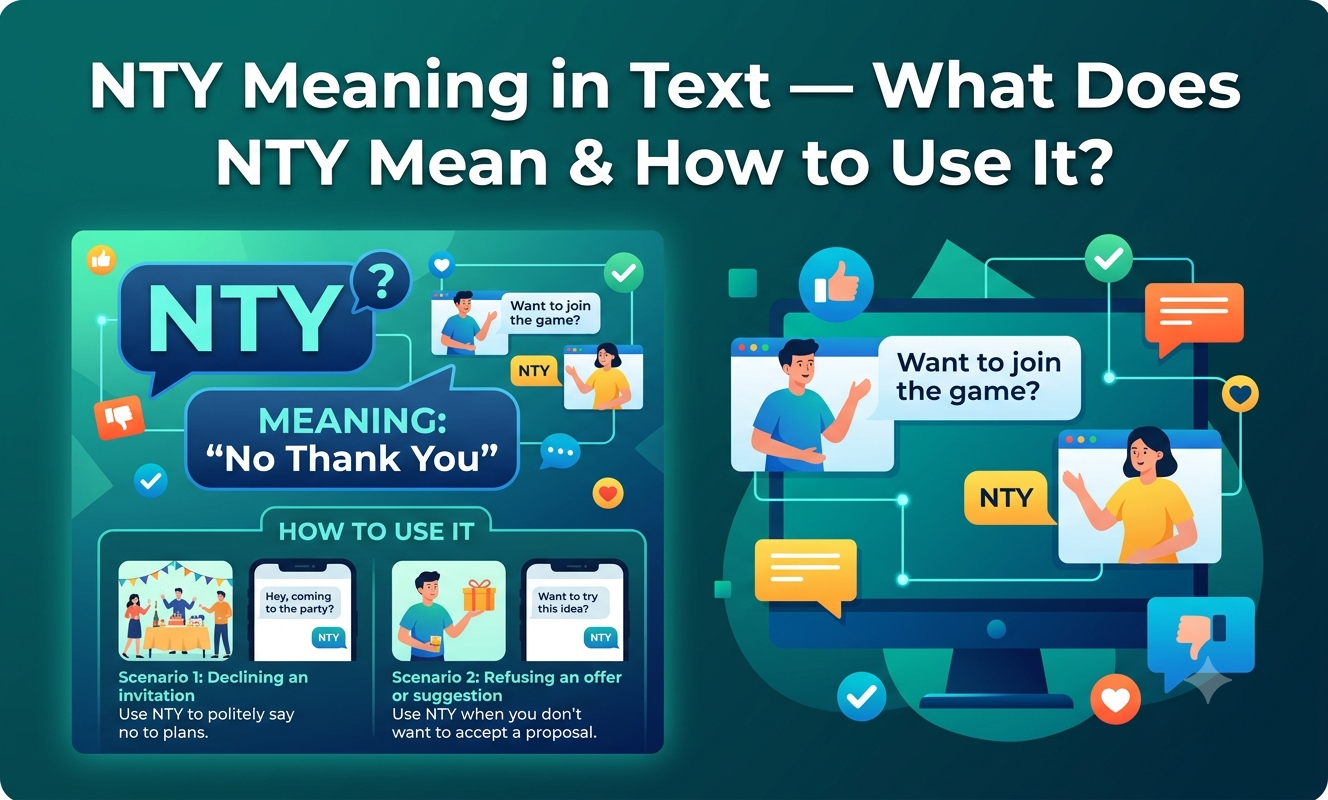
Quick Answer: NTY stands for “No Thank You.” It’s a short, casual way to politely decline something in a text message, DM, or comment. People use NTY to save time while still sounding polite, and it’s especially popular among teens and young adults on WhatsApp, Snapchat, TikTok, and Instagram.
Introduction
Ever gotten a text back that just says “nty” and wondered if you did something wrong? You’re not alone. Texting slang moves fast, and abbreviations pop up in group chats before parents (or even some teens) can keep up.
The nty meaning in text is simple: it’s short for “No Thank You.” It’s used when someone wants to decline an offer, invite, or suggestion quickly without typing out the full phrase. Think of it as the texting cousin of a polite head-shake.
In this article, you’ll learn exactly what NTY means, where it came from, how to use it correctly, and how it shows up differently across WhatsApp, Snapchat, TikTok, and Instagram in 2026. We’ll also cover whether it’s considered rude, how to reply to it, and similar slang terms you should know. By the end, you’ll never have to guess what NTY means again.
What Does NTY Mean?
NTY is a texting abbreviation that stands for “No Thank You.” It’s used to turn down an offer, invitation, or request in a quick, casual way — without sounding harsh or writing a full sentence.
The term isn’t brand new. It’s been floating around chat rooms and instant messaging apps since the early 2000s, alongside classics like LOL, BRB, and TTYL. But its usage has spiked again in recent years as texting culture shifted toward shorter, faster replies.
By 2026, messaging trends show that Gen Z and younger Gen Alpha users send an average of 15–20% more abbreviated replies than they did just three years ago, largely driven by voice-to-text habits, disappearing messages on Snapchat, and quick-reply culture on TikTok comments. NTY fits perfectly into this shift because it’s short, easy to type with one hand, and gets the point across instantly.
Unlike some slang that only younger users understand, NTY has crossed generational lines. Many parents and older millennials now recognize and even use it themselves, especially in group chats or when replying to spam-like offers, invites, or sales pitches.
NTY Full Form Explained
If you’re wondering exactly what each letter stands for, here’s the simple breakdown:
| Letter | Stands For | Meaning |
|---|---|---|
| N | No | A direct refusal |
| T | Thank | Politeness marker |
| Y | You | Directed at the person offering |
Put together, N-T-Y = “No Thank You.” It’s meant to be a polite decline, not a rude dismissal — the “thank you” part is what softens the “no.”
How to Use NTY — Real Examples
NTY can be used in many everyday texting situations, from turning down party invites to declining spam messages. Here are examples across different emotional tones so you can see how flexible it is.
| Situation | Example | Emotion |
|---|---|---|
| Declining a party invite | “Wanna come to Jake’s thing tonight?” — “nty, I’m tired 😴” | Polite/Casual |
| Turning down food | “Want some of my fries?” — “nty, I’m full” | Friendly |
| Rejecting a sales pitch | “Want to try our premium plan?” — “nty” | Neutral/Firm |
| Avoiding drama | “Should I text him back?” — “nty, leave it” | Cautious |
| Declining a game invite | “Join our squad for one more round?” — “nty, gotta sleep” | Relaxed |
| Saying no to a favor | “Can you cover my shift?” — “nty, I already have plans” | Assertive |
| Skipping a trend/challenge | “Do the trend with me!” — “nty 😂 I’ll watch though” | Playful |
| Declining unwanted advice | “You should really talk to him” — “nty, I’m good” | Slightly annoyed |
| Turning down a ride offer | “I can drop you home” — “nty, my mom’s picking me up” | Practical |
| Rejecting a follow-back request | “Follow me and I’ll follow you back” — “nty” | Blunt |
As you can see, the tone of NTY changes completely depending on punctuation, emojis, and context — which we’ll break down more in the next section.
NTY on Different Platforms (2026)
Slang doesn’t behave the same way on every app. Here’s how NTY is typically used across the most popular platforms in 2026.
On WhatsApp
WhatsApp remains the go-to app for family and group chats, so NTY is often used in a soft, polite way — especially when replying to relatives or work groups. In 2026, WhatsApp’s broadcast and community features have made group invites more frequent, which means quick declines like “nty” are showing up more often in status replies and group polls.
On Snapchat
On Snapchat, where messages disappear and conversations move fast, NTY is used almost like a reflex reply. With Snapchat’s 2026 update to quick-reaction stickers, many users now pair “nty” with a laughing or shrug emoji instead of typing a full sentence, especially when declining Snap game invites or streak-related requests.
On TikTok
TikTok comment sections are where NTY thrives the most. Creators often ask questions like “Would you try this?” and viewers reply with a quick “nty 💀” for comedic effect. In 2026, TikTok’s comment culture leans heavily into short, meme-style responses, and NTY has become a common way to express playful refusal without sounding harsh.
On Instagram
On Instagram, NTY shows up frequently in DMs and Story replies, particularly when someone declines a collab request, a shoutout trade, or a “add me on Snap” type message. Instagram’s 2026 vanish-mode DMs (private chats that auto-delete) have also made casual, short replies like NTY more common since users aren’t worried about the message being permanent.
Is NTY Rude or Offensive?
This is one of the most common questions people ask — and the honest answer is: it depends on context.
Why it can seem rude:
- Without emojis or a follow-up explanation, “nty” can come across as blunt or dismissive.
- In formal or professional conversations, using slang like NTY instead of a full polite reply may seem disrespectful.
- If sent in response to a heartfelt or genuine offer, a plain “nty” might feel cold.
Why it’s usually not rude:
- Among friends and peers, NTY is simply a faster way of saying no thank you — the politeness is already built into the phrase.
- Adding an emoji, a reason, or a lighthearted tone (like “nty lol” or “nty, maybe next time”) keeps it friendly.
- In casual digital spaces like TikTok comments or Snapchat, short replies are the norm, not an insult.
The general rule: NTY is polite by definition, but tone depends on where and how it’s used. In close friendships and casual apps, it’s completely normal. In formal settings — like texting a teacher, boss, or someone you don’t know well — it’s better to spell out “No, thank you” fully.
How to Reply to NTY
Not sure how to respond when someone texts you “nty”? Here are some natural, friendly ways to reply depending on the situation.
| Their Message | Your Reply | Tone |
|---|---|---|
| “nty” (declining invite) | “No worries, next time then!” | Friendly |
| “nty” (declining food) | “All good, more for me 😄” | Playful |
| “nty” (declining favor) | “That’s fine, I’ll ask someone else” | Understanding |
| “nty” (declining sales offer) | “No problem, have a good day!” | Professional |
| “nty” (short/blunt reply) | “Okay, just checking 👍” | Neutral |
| “nty” (from a close friend) | “Lol fair enough” | Casual |
The key is to match their energy — if they replied casually, keep your response light too. If it feels unusually blunt for the relationship, a simple check-in like “everything okay?” can clear up any confusion.
NTY Alternatives and Similar Slang
NTY isn’t the only shorthand people use to decline something. Here are other common texting abbreviations with similar or related meanings.
| Slang | Full Form | Meaning |
|---|---|---|
| NAH | No, not really | Casual refusal |
| IDC | I Don’t Care | Indifferent response, sometimes used to decline choices |
| NP | No Problem | Used after declining or agreeing, shows it’s fine |
| PASS | (Not an acronym) | Common way to say “I’ll skip this one” |
| IMO NTY | In My Opinion, No Thank You | Adds a personal opinion to the decline |
| HARD PASS | (Slang phrase) | A stronger, more emphatic version of NTY |
| NAW | No | Informal spelling variant of “no” |
| TY BUT NO | Thank You, But No | A slightly longer, softer alternative to NTY |
These terms are often interchangeable depending on how casual or firm you want your reply to sound.
Frequently Asked Questions (FAQ)
Q: What does NTY mean in text? A: NTY means “No Thank You.” It’s a quick, polite way to decline an offer, invite, or suggestion in a text message or DM.
Q: Is NTY the same as saying no? A: Yes, but with added politeness. Unlike a plain “no,” NTY softens the refusal by including “thank you,” making it sound more considerate.
Q: What does NTY mean on Snapchat? A: On Snapchat, NTY is used the same way as everywhere else — as a fast, casual decline. It’s often paired with reaction emojis or stickers for tone.
Q: Is NTY rude to say to someone? A: Not usually. NTY is polite by design since it literally means “no thank you.” It can seem blunt without emojis or context, but among friends it’s completely normal.
Q: What’s the difference between NTY and NAH? A: NTY means “No Thank You” and sounds more polite, while NAH is a more informal, casual way of simply saying “no” without the politeness marker.
Q: Can NTY be used in professional messages? A: It’s best avoided in formal settings. For work emails or messages to teachers, elders, or professionals, it’s better to write out “No, thank you” in full.
Q: Why do teens use NTY instead of typing the full phrase? A: Teens use NTY because it’s faster to type, fits casual texting culture, and works well in fast-paced apps like TikTok comments and Snapchat chats.
Conclusion
NTY is one of those small texting abbreviations that makes everyday conversations faster without losing politeness. Now that you know the full nty meaning in text — “No Thank You” — you can use it confidently, understand it when a friend sends it, and know when it’s better to spell things out instead.
From WhatsApp group chats to TikTok comment sections, NTY has become a normal part of how people communicate online in 2026. Whether you’re a teen using it daily or a parent trying to keep up with your kid’s texts, this guide has you covered.
Also read IDEK Meaning in Text — What Does IDEK Mean & How to Use It?
