
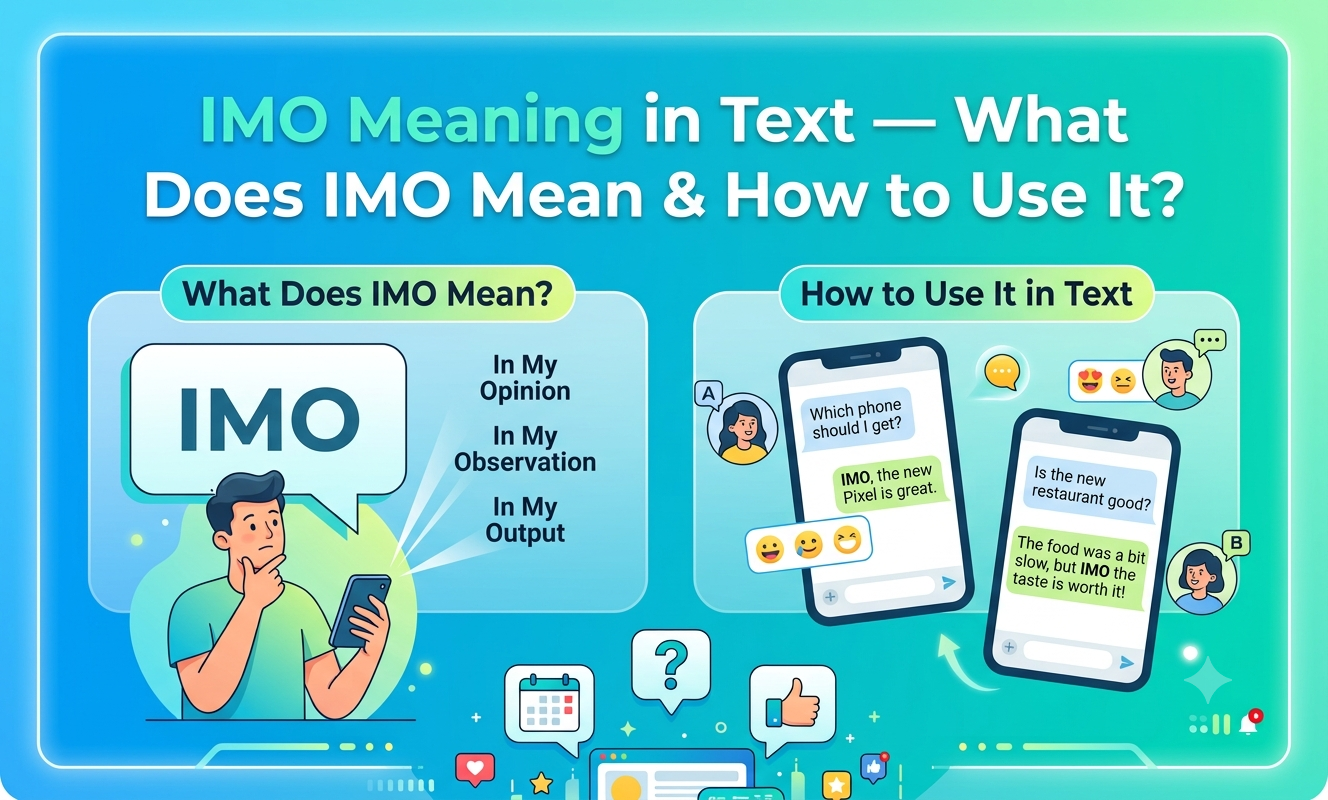
Quick Answer: IMO stands for “In My Opinion.” People text it right before sharing a personal view, so the other person knows it’s an opinion and not a fact. You’ll see it in group chats, comment sections, and DMs — usually lowercase, often at the start or end of a sentence.
Introduction
Someone texts you “imo the new season was mid” and you’re left wondering what it even means. You’re not alone — imo meaning in text is one of the most searched texting abbreviations, especially among teens and the parents trying to keep up with them.
IMO simply means “In My Opinion.” It’s a small tag people add to a message to soften a statement or make clear they’re sharing a personal take rather than stating a fact.
In this article, you’ll learn where IMO came from, how to use it correctly, what it looks like on WhatsApp, Snapchat, TikTok, and Instagram, whether it can come across as rude, how to reply to it, and which similar abbreviations you should know.
What Does IMO Mean?
IMO stands for “In My Opinion.” It’s used to signal that whatever comes next is a personal viewpoint, not a proven fact or universal truth.
It belongs to a family of internet abbreviations that grew out of early online forums and instant messaging, where typing fast mattered more than typing formally. Abbreviations like LOL, BRB, and IMO let people communicate quickly without sounding cold or overly blunt.
By 2026, IMO has settled firmly into everyday texting, group chats, and social comment sections. It’s no longer seen as “internet slang” so much as a normal part of casual written communication — used by teens, adults, and even in some workplace chat tools when someone wants to flag that they’re sharing a personal take rather than an official position.
Example:
“IMO, the movie was way too long.”
This tells the reader: this is just how I feel about it — you might feel differently, and that’s fine.
IMO Full Form Explained
IMO is an acronym, meaning each letter stands for a word in the phrase.
| Letter | Stands For |
|---|---|
| I | In |
| M | My |
| O | Opinion |
So I-M-O = In My Opinion.
A closely related, slightly stronger version is IMHO, which stands for “In My Humble Opinion.” Both mean roughly the same thing — IMHO just adds a touch of modesty to the phrasing.
How to Use IMO — Real Examples
IMO works in almost any conversation where someone wants to share a take without sounding like they’re lecturing. Below are examples across different emotional tones.
| Situation | Example | Emotion |
|---|---|---|
| Movie discussion | “IMO the sequel was better than the original.” | Casual |
| Group chat debate | “Imo we should just order pizza instead of cooking.” | Playful |
| Giving honest feedback | “IMO your essay’s intro is strong but the ending feels rushed.” | Constructive |
| Disagreeing gently | “Imo that’s not really fair to him, but I get your point.” | Diplomatic |
| Fashion opinion | “IMO the red one looks way better on you.” | Supportive |
| Sports talk | “Imo that ref made the wrong call.” | Frustrated |
| Music taste | “IMO their old albums hit different than the new stuff.” | Nostalgic |
| Relationship advice | “IMO you deserve someone who actually texts back.” | Caring |
| Food review | “Imo this place is overrated ngl.” | Blunt |
| School/work opinion | “IMO the deadline is too tight for this project.” | Concerned |
Notice how IMO can appear at the start or end of a sentence, and it’s almost always written in lowercase in casual texting — capitalization doesn’t change the meaning.
IMO on Different Platforms (2026)
The way IMO gets used shifts slightly depending on the platform, mostly because of how conversations flow on each one.
On WhatsApp
In WhatsApp group chats — especially family or friend groups — IMO usually shows up during debates about plans, restaurants, or shared decisions. Voice notes have become more common on WhatsApp, but IMO still shows up heavily in quick text replies when someone wants to weigh in fast without recording a whole voice message.
On Snapchat
On Snapchat, conversations tend to be short and back-and-forth, so IMO often appears as a one-word-style reaction to a snap or chat message, like “imo yes” or “imo skip it.” It’s less formal here than almost anywhere else.
On TikTok
In TikTok comment sections, IMO is extremely common because comments are public and people want to flag that they’re sharing a personal take rather than starting an argument. You’ll often see it paired with other slang, like “imo this trend needs to end fr.”
On Instagram
On Instagram, IMO shows up frequently in comments on posts and Reels, as well as in DMs when friends are discussing outfits, photos, or captions. It’s a quick way to give feedback without sounding overly critical.
Across all these platforms, the core meaning of IMO stays the same — only the tone and pacing shift slightly based on how people typically chat there.
Is IMO Rude or Offensive?
IMO is not inherently rude or offensive. In fact, it often does the opposite — it softens a statement by clearly labeling it as a personal opinion rather than a fact or a criticism aimed at the reader.
Why it’s usually seen as polite:
- It signals humility (“this is just my take”).
- It leaves room for disagreement without conflict.
- It’s commonly used even in constructive or supportive messages.
When it can come across poorly:
- If the opinion itself is harsh or dismissive, adding “IMO” doesn’t fix that — the tone of the sentence still matters.
- In very formal settings (like a professional email to a client), it can seem too casual.
- Sarcastic use (“IMO you should just quit lol”) can land as passive-aggressive depending on context and relationship.
The general rule: IMO softens tone, but it doesn’t excuse rudeness. Context and the words around it matter more than the abbreviation itself.
How to Reply to IMO
Replying to a message that includes IMO is usually simple — you’re just responding to someone’s opinion.
| Their Message | Your Reply | Tone |
|---|---|---|
| “IMO the show got worse after season 2.” | “Nah I actually think it got better lol” | Disagreeing casually |
| “Imo you should just talk to him directly.” | “Yeah you’re probably right, I’ll try that.” | Agreeing |
| “IMO this restaurant is overpriced.” | “Fair, but the food is really good though.” | Partial agreement |
| “Imo we should cancel the trip.” | “Wait really? Why do you think that?” | Curious/asking more |
| “IMO your photo looks better in black and white.” | “Ooh good call, let me try that.” | Appreciative |
| “Imo that was a bad decision.” | “I hear you, but here’s why I did it…” | Explaining your side |
There’s no special etiquette required — you can agree, disagree, or ask follow-up questions just like you would with any other opinion.
IMO Alternatives and Similar Slang
If you want to mix things up or better understand related abbreviations, here are common alternatives.
| Term | Meaning |
|---|---|
| IMHO | In My Humble Opinion |
| TBH | To Be Honest |
| NGL | Not Gonna Lie |
| FWIW | For What It’s Worth |
| IIRC | If I Recall Correctly |
| AFAIK | As Far As I Know |
| IMEO | In My Educated Opinion (less common) |
| JMO | Just My Opinion |
These terms all serve a similar purpose: framing a statement as personal, uncertain, or non-authoritative, which keeps conversations friendly and low-pressure.
Frequently Asked Questions (FAQ)
Q: What does IMO mean in text? A: IMO means “In My Opinion.” It’s used before or after a statement to show it’s a personal view, not a fact.
Q: Is IMO the same as IMHO? A: They’re very similar. IMHO stands for “In My Humble Opinion” and is just a slightly more modest version of IMO.
Q: Can IMO be used in professional messages? A: It’s generally too casual for formal emails or client communication, but it’s fine in casual workplace chats like Slack or Teams among close coworkers.
Q: Does IMO mean someone is unsure of their opinion? A: Not necessarily — it just signals that they’re sharing a personal take rather than claiming it as an objective fact.
Q: Is it rude to say “IMO” before disagreeing with someone? A: No, it’s usually seen as a respectful way to disagree, since it frames the response as your personal view rather than a correction.
Q: What’s the difference between IMO and TBH? A: IMO frames a statement as an opinion, while TBH (“To Be Honest”) frames a statement as a truthful or blunt admission — they’re often used interchangeably in casual texting.
Conclusion
IMO is a simple, widely used abbreviation for “In My Opinion,” and by 2026 it’s become a normal part of everyday texting across WhatsApp, Snapchat, TikTok, and Instagram. It’s generally polite, softens disagreements, and works well in almost any casual conversation. Whether you’re chatting with friends or scrolling through comment sections, knowing the imo meaning in text helps you follow — and join — the conversation with confidence. Bookmark this page next time you spot an unfamiliar text abbreviation and need a quick, reliable answer.
Also read MYF Meaning in Text — What Does MYF Mean & How to Use It?
