
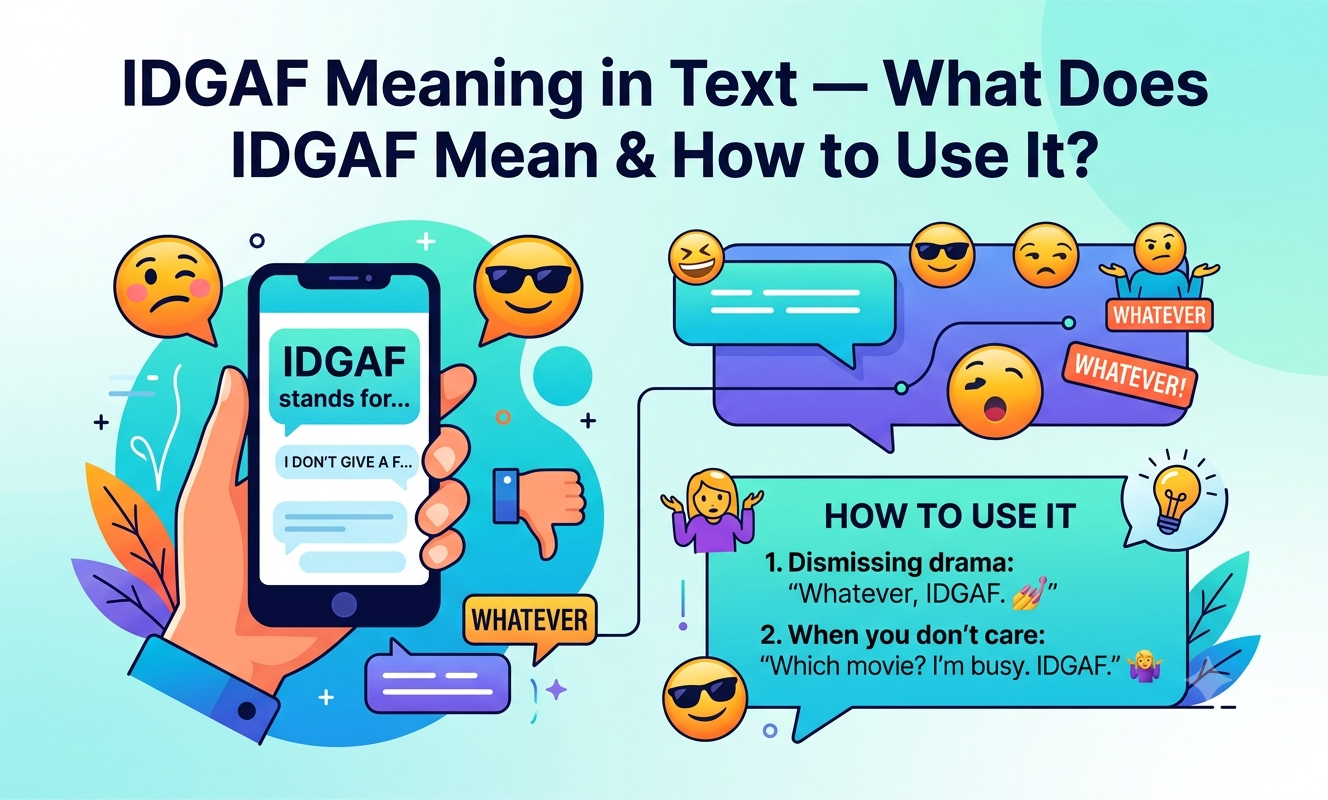
Quick Answer: IDGAF is a texting abbreviation that stands for “I Don’t Give A Fk.”** It’s used to express that someone feels indifferent, unbothered, or doesn’t care about a situation, opinion, or outcome. It shows up constantly in texts, DMs, captions, and comments across WhatsApp, Snapchat, TikTok, and Instagram.
Introduction
Ever gotten a text back that just said “idgaf” and wondered if you’d upset someone — or if they just genuinely couldn’t care less? You’re not alone. The idgaf meaning in text trips up a lot of people, especially parents trying to keep up with how their kids actually talk online.
This guide breaks down exactly what IDGAF means, where it came from, how bold or rude it really is, and how to use (or reply to) it the right way. We’ll walk through real texting examples, platform-specific trends for 2026, similar slang terms, and answers to the most common questions people search for. By the end, you’ll never have to guess what someone meant by it again.
What Does IDGAF Mean?
IDGAF is an acronym for “I Don’t Give A Fk.”** It’s a blunt, informal way of saying someone is indifferent to a situation — they don’t care about the outcome, other people’s opinions, or the consequences of something.
The phrase itself has existed in spoken slang for decades, but the shortened texting version, IDGAF, took off with the rise of SMS and early social media in the 2010s. It picked up serious momentum again through hashtags, memes, and song lyrics, and by 2026 it’s considered a fully mainstream piece of internet vocabulary — used casually across texting apps, comment sections, and captions rather than being seen as edgy slang reserved for a niche group.
Unlike some slang that fades quickly, IDGAF has stayed relevant because it captures a very specific emotional tone: confident detachment. It’s less about anger and more about not letting something affect you — which is part of why it’s remained popular with Gen Z and younger millennials well into 2026.
IDGAF Full Form Explained
Breaking the acronym down letter by letter makes it easy to remember and explains why the tone feels so casual and direct.
| Letter | Stands For |
|---|---|
| I | I |
| D | Don’t |
| G | Give |
| A | A |
| F | F**k |
Put together, it reads: “I Don’t Give A Fk.”** Some people soften it in writing as “IDGAF” without ever spelling out the full phrase, which is part of why it feels less harsh in text than it might sound out loud.
How to Use IDGAF — Real Examples
IDGAF shows up in a lot of different emotional contexts — not just anger. Here are examples across common situations.
| Situation | Example | Emotion |
|---|---|---|
| Being judged by others | “People keep talking about my outfit, but idgaf” | Confidence |
| Ignoring drama | “They’re still mad about it? idgaf honestly” | Indifference |
| Standing up for yourself | “You can disagree, idgaf, I’m doing it my way” | Assertiveness |
| Reacting to bad news calmly | “Lost my spot on the team, idgaf, there’s always next season” | Resilience |
| Responding to gossip | “She’s been talking behind my back but idgaf what she thinks” | Detachment |
| Making a bold decision | “Quitting my job tomorrow, idgaf what anyone says” | Determination |
| Playful/joking context | “Forgot your birthday lol idgaf jk happy birthday 😂” | Humor |
| Dismissing criticism | “My grades slipped a bit, idgaf, I’ll fix it next term” | Nonchalance |
| Venting frustration | “Traffic made me late again, idgaf anymore, I’m used to it” | Frustration (masked) |
| Setting a boundary | “Not explaining myself again, idgaf if that upsets you” | Boundary-setting |
Notice how the same three-word phrase can shift between playful, defiant, tired, or confident depending on the conversation — tone almost always comes from context, not the acronym itself.
IDGAF on Different Platforms (2026)
How IDGAF gets used can vary slightly depending on the app. Each platform has its own texting culture, and 2026 trends show some clear patterns.
On WhatsApp
WhatsApp usage tends to be more personal and one-on-one, so IDGAF here often shows up in private venting conversations between close friends or partners — usually about family drama, work stress, or relationship frustrations rather than public posts.
On Snapchat
Snapchat’s disappearing message format makes IDGAF a popular quick reaction in chats, especially paired with emojis or short voice notes. Because Snaps vanish, people tend to use it more freely without worrying about it being screenshotted — though screenshotting is still common enough that caution matters.
On TikTok
On TikTok, IDGAF shows up heavily in captions and comment sections, often tied to confidence-themed content, “unbothered” aesthetic videos, or reaction clips. In 2026, it’s frequently paired with trending audio about self-respect or moving on from toxic situations.
On Instagram
Instagram sees IDGAF mostly in story replies, captions, and bio lines, often as a short statement of personal attitude (“living my life, idgaf what you think”). It’s less common in formal comments on brand or business posts.
Across all four platforms, 2026 data on youth texting behavior consistently shows abbreviations like IDGAF are used more for tone-setting than for literal indifference — it’s often more about projecting confidence than truly not caring.
Is IDGAF Rude or Offensive?
This depends heavily on context, tone, and who’s using it.
Why some see it as rude:
- It contains a censored swear word, which some people find inappropriate in casual or professional settings.
- Used aggressively, it can come across as dismissive or cold toward someone’s feelings.
- In a serious conversation (like an argument), it can escalate tension instead of resolving it.
Why others see it as harmless:
- Among friends, it’s often just a casual way to express confidence or brush off small annoyances.
- It’s rarely meant as a personal attack — more often it’s about the situation, not the person.
- Many young people use it so frequently that it’s lost most of its shock value, similar to other common slang.
Bottom line: IDGAF isn’t inherently offensive, but it depends on the relationship and setting. Sent to a close friend, it’s usually fine. Sent to a boss, teacher, or in a formal message, it can easily be read as disrespectful.
How to Reply to IDGAF
If someone sends you IDGAF, your reply should match the tone they intended — supportive, playful, or concerned, depending on context.
| Their Message | Your Reply | Tone |
|---|---|---|
| “idgaf what they think” | “Good, you shouldn’t have to” | Supportive |
| “idgaf anymore, I’m done” | “Wait, what happened? Talk to me” | Concerned |
| “lol idgaf, doing it anyway” | “Go off then 😂” | Playful |
| “idgaf about the grade tbh” | “Fair, as long as you’re okay” | Reassuring |
| “idgaf what he says” | “That’s the energy we need” | Encouraging |
| “idgaf, I’m over it” | “Proud of you for letting it go” | Positive reinforcement |
If the message seems to hint at real hurt or exhaustion rather than genuine confidence, it’s worth checking in directly instead of just matching the casual tone.
IDGAF Alternatives and Similar Slang
IDGAF isn’t the only acronym used to express indifference or confidence. Here are similar terms people use in texts.
| Slang | Meaning |
|---|---|
| IDC | I Don’t Care |
| IDK | I Don’t Know |
| NBD | No Big Deal |
| SMH | Shaking My Head |
| TBH | To Be Honest |
| YOLO | You Only Live Once |
| WYA | Where You At |
| IJS | I’m Just Saying |
Of these, IDC is the closest in meaning to IDGAF but is considered much milder and more polite, making it a safer option for mixed company or formal-ish texting.
Frequently Asked Questions (FAQ)
Q: What does IDGAF mean in text? A: IDGAF means “I Don’t Give A F**k” — it’s used to express indifference, confidence, or that someone isn’t bothered by a situation or opinion.
Q: Is IDGAF the same as IDC? A: They’re similar, but IDGAF (“I Don’t Give A F**k”) is stronger and more blunt, while IDC (“I Don’t Care”) is considered milder and more casual-polite.
Q: Is it okay to use IDGAF with parents or teachers? A: Generally no — because it contains a censored swear word, it’s better suited for texting friends rather than formal or respectful conversations with adults in authority.
Q: Where did IDGAF originate? A: It grew out of general internet and texting slang culture in the 2010s and became widely popular through social media, song lyrics, and meme culture, remaining common through 2026.
Q: Does IDGAF always mean someone is angry? A: No — it can express humor, confidence, resilience, or calm detachment just as often as frustration. Tone depends heavily on the rest of the message and context.
Q: What’s a polite way to say the same thing as IDGAF? A: Phrases like “I’m not too worried about it” or “That doesn’t bother me” carry a similar meaning without any strong language.
Conclusion
The idgaf meaning in text comes down to one simple idea: not letting something get to you. Whether it’s used to shrug off criticism, brush off drama, or show confidence in a decision, IDGAF has become a staple of everyday digital conversation by 2026 — especially across WhatsApp, Snapchat, TikTok, and Instagram.
Understanding the tone behind it — and knowing when it’s appropriate to use — makes it much easier to read texts accurately and respond the right way. Bookmark this page next time a text full of abbreviations leaves you confused.
Also read PS Meaning in Text — What Does PS Mean & How to Use It?
