
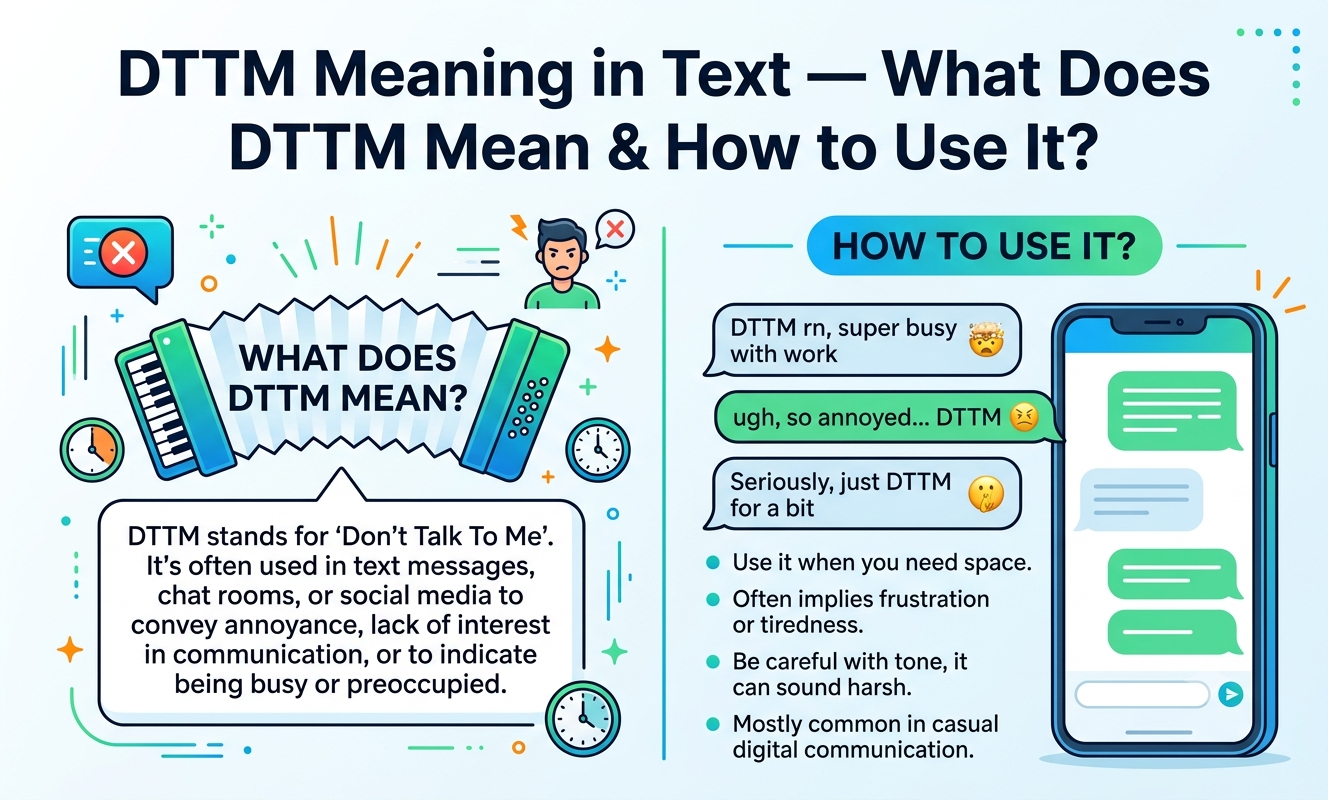
DTTM meaning in text is “Don’t Talk To Me.” It’s a texting abbreviation people use when they want space, are upset, tired, or just not in the mood to chat. It can be playful and joking, or it can signal genuine frustration — the tone depends entirely on the context and who’s saying it.
Quick Answer
If a friend texts you DTTM, they’re telling you to back off — for now. It’s short, blunt, and common in group chats, Snapchat streaks, and comment sections. Whether it’s a joke or a real boundary usually comes down to punctuation, emojis, and the conversation right before it.
Texting abbreviations move fast, and dttm meaning in text is one that trips up a lot of parents and even some teens who see it for the first time. In this article, you’ll learn exactly what DTTM stands for, where it came from, how people use it across WhatsApp, Snapchat, TikTok, and Instagram, whether it’s considered rude, and how to reply if someone sends it to you. We’ll also cover similar slang so you’re never left guessing again.
What Does DTTM Mean?
DTTM stands for “Don’t Talk To Me.” It’s a texting shorthand people use to shut down a conversation — sometimes seriously, sometimes as a joke between friends.
The phrase itself isn’t new; “don’t talk to me” has been a common expression for decades. What changed is how it gets typed. As texting and messaging apps replaced phone calls, people started shortening common phrases into acronyms to type faster, and DTTM became one of many that stuck.
It’s grown especially common in casual texting and social media captions, often paired with a mood — tired, annoyed, focused, or overwhelmed. You’ll also see it used humorously, like a caption under a photo of someone drinking coffee before 9 a.m., meaning “I need my space until I’ve had caffeine.”
Context is everything with DTTM. The same three letters can mean “I’m genuinely upset, give me space” or “I’m being dramatic for comedic effect,” and readers usually pick up on which one it is based on tone, emojis, and what was said just before it.
DTTM Full Form Explained
Here’s a simple breakdown of what each letter stands for:
| Letter | Stands For |
|---|---|
| D | Don’t |
| T | Talk |
| T | To |
| M | Me |
Put together: Don’t Talk To Me.
It’s a straightforward acronym — no hidden meaning or alternate expansion — which is part of why it’s easy to pick up even for people newer to texting slang.
How to Use DTTM — Real Examples
DTTM shows up in a range of moods. Here are examples across different emotional contexts to show how flexible the phrase really is.
| Situation | Example | Emotion |
|---|---|---|
| Woke up too early | “DTTM until I’ve had coffee ☕” | Playful/tired |
| After a bad day at school | “today was rough, DTTM for a bit” | Genuine frustration |
| Sibling being annoying | “DTTM I’m trying to study” | Mild annoyance |
| Joking with friends | “DTTM I’m in my villain era 😂” | Humorous/exaggerated |
| Feeling overwhelmed | “so much homework rn, DTTM” | Stressed |
| Monday morning mood | “DTTM it’s Monday” | Sarcastic |
| After an argument | “just DTTM right now, need space” | Serious/upset |
| Focused on a task | “in the zone, DTTM till this is done” | Focused |
| Social media caption | Photo caption: “DTTM energy today” | Lighthearted |
| Group chat response | “DTTM 💀 I need silence” | Exaggerated humor |
Notice how punctuation and added words shift the tone. “DTTM 😂” reads very differently from “just DTTM.” — one invites a laugh, the other asks for actual space.
DTTM on Different Platforms (2026)
Texting slang doesn’t behave the same way everywhere. Each platform has its own rhythm, and DTTM adapts to fit.
On WhatsApp
WhatsApp conversations tend to be longer and more personal, often between people who already know each other well — family groups, close friends, or coworkers. On WhatsApp, DTTM is more likely to appear in a genuine context, like telling a family member you need a moment after a stressful day, since the platform skews toward closer, ongoing relationships rather than quick public posts.
On Snapchat
Snapchat’s fast, disappearing nature makes DTTM feel more casual and momentary. It often shows up as a quick snap caption — paired with a tired selfie or an “over it” expression — and disappears within the day, matching Snapchat’s throwaway, in-the-moment communication style.
On TikTok
On TikTok, DTTM tends to show up in comments and captions tied to relatable, humorous content — think “me before my morning coffee” or “me on Mondays” style videos. Here it’s rarely meant literally; it’s part of the exaggerated, self-deprecating humor that’s popular in TikTok comment sections.
On Instagram
Instagram usage often falls between the two — it appears in captions on Stories (similar to Snapchat’s momentary use) and in comments under relatable meme accounts (similar to TikTok’s humor-driven use). It’s less common in Instagram DMs unless the tone is already playful between the two people texting.
Across all platforms, one 2026 trend holds steady: younger users tend to use DTTM humorously far more often than literally, while its “serious” use is more common in one-on-one chats than public posts or comments.
Is DTTM Rude or Offensive?
DTTM isn’t offensive slang, but it can come across as rude depending on how and when it’s used.
Why it can seem rude: Sent bluntly, with no punctuation, emoji, or explanation, DTTM can feel dismissive — especially to someone who wasn’t expecting to be shut down mid-conversation.
Why it’s usually not a big deal: Most of the time, it’s shorthand for “I need a minute,” not a personal attack. Among friends, it’s often used jokingly and isn’t meant to hurt anyone’s feelings.
The safest way to read it: consider who sent it, what was said before, and whether there’s an emoji or laughing tone attached. A “DTTM 😂” after a joke is very different from a flat “dttm.” sent after a disagreement.
How to Reply to DTTM
If someone sends you DTTM, how you respond depends on whether it seems playful or genuine. Here are a few reply options for either case.
| Tone You Want | Reply Example |
|---|---|
| Respect their space | “okay, here when you’re ready” |
| Keep it light | “lol okay bestie, go be dramatic” |
| Check in gently | “all good? here if you want to talk” |
| Match the humor | “DTTM too honestly 😂” |
| Give them room | “no worries, text me later” |
| Show you care | “okay taking space, love you though” |
Generally, the best move is to respect the request first, then follow up later if you’re genuinely concerned about them.
DTTM Alternatives and Similar Slang
DTTM belongs to a small family of texting phrases that express needing space or being unbothered. Here are some related terms.
| Slang | Meaning |
|---|---|
| IDC | I Don’t Care |
| NVM | Never Mind |
| BRB | Be Right Back |
| GTG | Got To Go |
| LMK | Let Me Know |
| IB | I’m Back |
| STFU | Shut The… (more forceful, ruder version) |
| TTYL | Talk To You Later |
DTTM sits somewhere between playful and firm — less harsh than STFU, but more direct than a soft “nvm” or “gtg.”
Frequently Asked Questions (FAQ)
Q: What does DTTM mean in text? A: DTTM means “Don’t Talk To Me.” It’s used when someone wants space, whether they’re genuinely upset, tired, or just being playful.
Q: Is DTTM a rude thing to say? A: It depends on context. Sent bluntly it can feel dismissive, but among friends it’s often lighthearted and not meant to offend.
Q: What’s the difference between DTTM and STFU? A: DTTM is a softer, more casual way of asking for space. STFU is a much harsher, ruder phrase and shouldn’t be treated the same way.
Q: How do I know if DTTM is a joke or serious? A: Look at the punctuation, emojis, and what was said beforehand. A laughing emoji usually signals a joke; a flat, short message without context often means it’s genuine.
Q: What should I text back if someone sends me DTTM? A: A simple, respectful reply works best — something like “okay, here when you’re ready” — unless the tone is clearly joking, in which case you can match their humor.
Q: Is DTTM only used by teens? A: It’s most common among teens and younger texters, but the abbreviation has spread widely enough that people of many ages use it in casual texting.
Final Thoughts
DTTM is a simple, common texting abbreviation for “Don’t Talk To Me,” used far more often in a joking or lightly frustrated way than as an actual rejection. Reading the tone — through emojis, punctuation, and context — is the easiest way to tell whether someone genuinely wants space or is just being playful. Now that you know the dttm meaning in text, you’ll never be confused seeing it pop up on WhatsApp, Snapchat, TikTok, or Instagram again. Bookmark this page next time a new piece of texting slang catches you off guard.
Also read ETC Meaning in Text — What Does ETC Mean & How to Use It?
