
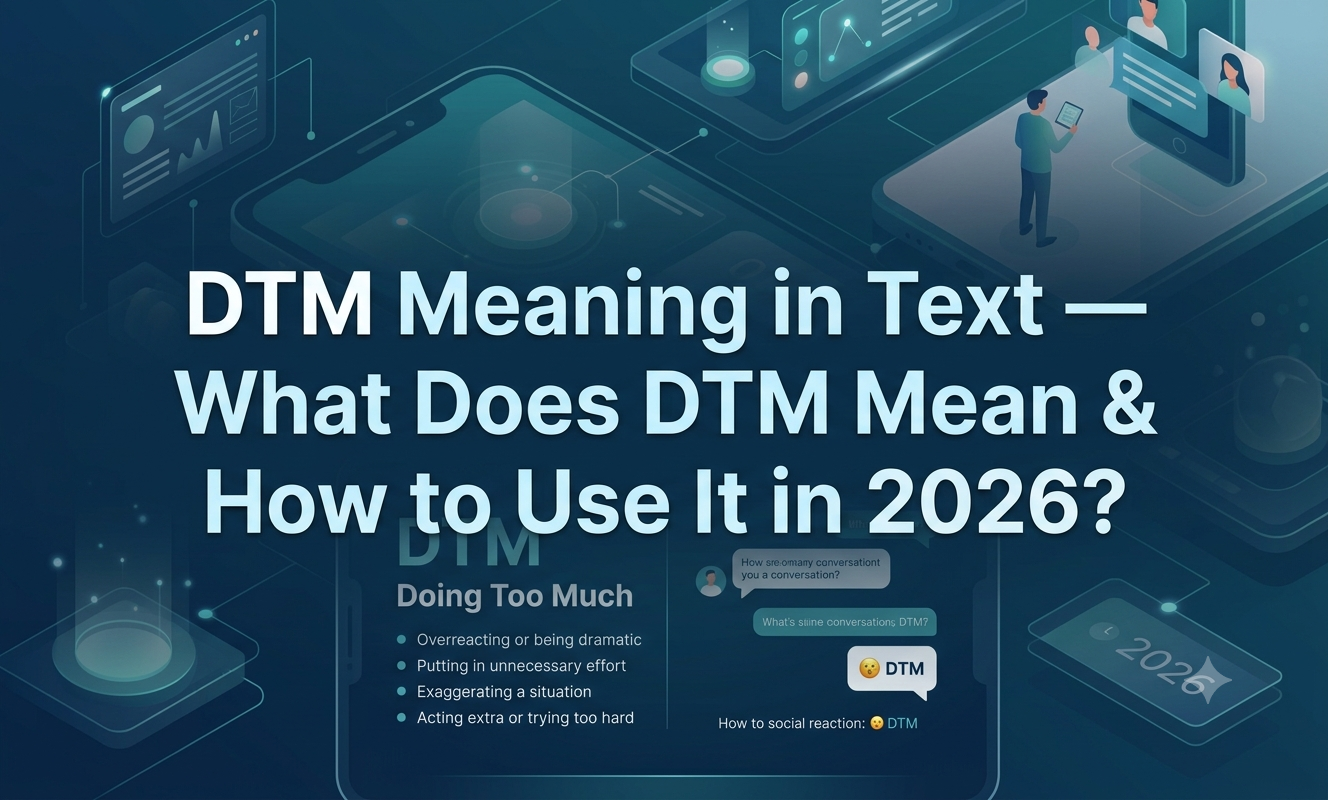
Quick Answer: DTM in text most commonly means “Doing Too Much.” It’s used when someone is being extra, overreacting, or putting in way more effort than a situation calls for. Depending on context, it can also mean “Dead To Me,” “Don’t Text Me,” or “Down To Meet.”
So, Someone Just Sent You “DTM” — Now What?
Picture this: your friend sends a wall of paragraphs explaining why they’re ten minutes late, and you reply with a single “DTM.” No further explanation needed, right? That’s the magic of internet slang — three letters can carry an entire reaction.
If you’ve landed here because a text, comment, or DM left you scratching your head, you’re not alone. The dtm meaning in text question is one of the most searched slang queries of 2026, especially among Gen Z and the parents trying to keep up with them.
In this guide, you’ll learn exactly what DTM stands for, where it came from, how it’s used across every major app, whether it’s rude, and how to reply when someone drops it on you. Let’s break it down.
What Does DTM Mean?
DTM is a piece of internet slang that most commonly stands for “Doing Too Much.” It’s a casual way of calling out behavior that feels exaggerated, over-the-top, or unnecessarily dramatic — the texting equivalent of saying “relax” or “chill out.”
The phrase itself isn’t new. “Doing too much” has been part of everyday conversational English, particularly in African American Vernacular English (AAVE), for a long time. What changed is that texting culture and social media compressed the phrase into a fast, three-letter shortcut that fits neatly into a comment or a DM.
By 2026, DTM has become a fixture of Gen Z and younger millennial texting habits. It shows up constantly in TikTok comment sections, Snapchat replies, and Instagram captions, and it has settled into everyday digital vocabulary the same way “lol” or “smh” once did. It’s rarely meant to be cruel — more often it’s a light jab, a joke between friends, or a gentle nudge to tone something down.
That said, DTM isn’t a one-meaning acronym. Tone, platform, and relationship all shape what it actually communicates, which is exactly why so many people end up confused when they first see it.
DTM Full Form Explained
Because DTM is used loosely across different online communities, it doesn’t have just one “official” full form. Here’s a simple breakdown of the meanings you’re likely to run into:
| Letter Breakdown | Full Form | How Common It Is |
|---|---|---|
| D-T-M | Doing Too Much | Most common — used casually every day |
| D-T-M | Dead To Me | Occasional — used in serious or dramatic contexts |
| D-T-M | Don’t Text Me | Less common — used to set a boundary |
| D-T-M | Down To Meet | Niche — used in dating or hangout planning |
The safest assumption, unless the context clearly says otherwise, is that DTM means “Doing Too Much.” If the message feels emotionally heavy, cold, or final, “Dead To Me” or “Don’t Text Me” may be intended instead. If it shows up while making weekend plans, it’s probably “Down To Meet.”
How to Use DTM — Real Examples
Seeing DTM used in different emotional situations makes the meaning click a lot faster. Here are examples across a range of everyday texting moods.
| Situation | Example | Emotion |
|---|---|---|
| Friend overreacting to small delay | “You wrote three paragraphs about being 5 minutes late… DTM 😂” | Playful teasing |
| Someone posting excessive selfies | “She posted 15 photos from one dinner, DTM” | Light mockery |
| Dramatic breakup story | “He cried at the mall over a text? DTM” | Amused disbelief |
| Genuine frustration with a friend | “Stop making everything a competition, you’re DTM” | Mild annoyance |
| Overdressed for a casual hangout | “It’s a backyard BBQ not a gala, you’re so DTM” | Friendly sarcasm |
| Setting a real boundary | “After what you said, DTM.” (meaning Don’t Text Me) | Serious, firm |
| Ending a friendship over conflict | “After that lie, you’re DTM to me now” | Hurt, final |
| Planning a casual hangout | “DTM this weekend if you’re free?” | Casual interest |
| Exaggerated reaction to a movie | “She cried for 20 minutes after a Pixar movie, DTM” | Humorous exaggeration |
| Over-preparing for a small event | “He made a slideshow for a two-person picnic, DTM” | Playful disbelief |
Notice how the same three letters shift meaning depending entirely on tone and the relationship between the people texting. Punctuation matters too — a cheerful “DTM lol” reads very differently from a flat “dtm.” with no emoji.
DTM on Different Platforms (2026)
Slang doesn’t behave the same way everywhere. Here’s how DTM shows up across the apps teens and young adults use most in 2026.
On WhatsApp
WhatsApp usage of DTM tends to be more personal, since conversations happen mostly between people who already know each other well. It’s typically used affectionately — teasing a sibling, close friend, or partner for being extra in a group chat, rather than as a way to shut someone down.
On Snapchat
Snapchat’s fast, disappearing-message culture makes DTM a quick reaction to a Snap or Story. Someone posts an overly dramatic caption about their day, and a friend replies “DTM” as a snapback comment. Because Snapchat conversations are informal and immediate, this is one of the most common places to see the slang used casually and repeatedly.
On TikTok
TikTok comment sections are where DTM thrives in 2026. It shows up constantly under videos featuring over-the-top reactions, dramatic storytimes, or exaggerated “get ready with me” content. Creators sometimes even lean into it, captioning their own videos “I know I’m DTM but—” before showing something intentionally excessive, turning the slang into a bit of self-aware humor.
On Instagram
On Instagram, DTM often appears in comments under Reels or in DMs reacting to a friend’s Story. It’s frequently paired with laughing emojis, since Instagram’s audience skews slightly older than TikTok’s, and the tone tends to be a little more restrained — still playful, but less meme-heavy.
Across all four platforms, the core meaning stays consistent: someone is being extra, and DTM calls it out — usually with a wink rather than genuine hostility.
Is DTM Rude or Offensive?
This depends entirely on context, tone, and who’s saying it.
The case that it’s harmless: Among close friends, DTM is almost always playful. It’s the digital version of rolling your eyes at a friend’s dramatics — affectionate teasing, not an attack. Most people who use it daily don’t intend any real offense.
The case that it can sting: Tone doesn’t travel well through text. A short, flat “dtm” with no emoji or punctuation can come across as dismissive or judgmental, especially if it’s sent to someone you’re not close with. Used repeatedly, or aimed at someone’s genuine emotions rather than a lighthearted overreaction, it can feel like you’re mocking them for caring too much — which can hurt.
Context matters most. DTM sent to a close friend during a joking exchange is very different from DTM sent to someone sharing something vulnerable. If there’s any doubt about how it’ll land, it’s usually better to skip the slang and just say what you mean.
How to Reply to DTM
If someone sends you DTM, your reply should match their tone. Here are a few solid options depending on the vibe:
| Their Tone | Your Reply | Why It Works |
|---|---|---|
| Playful/joking | “Lol fair, I got carried away 😂” | Shows you’re in on the joke |
| Teasing but light | “Okay maybe a little DTM, no regrets” | Owns it with humor |
| Slightly annoyed | “Noted, I’ll tone it down” | Diffuses tension calmly |
| You disagree it’s excessive | “I don’t think so, but okay 😅” | Pushes back gently, no drama |
| Serious/cold “DTM” | “Did I do something to upset you?” | Opens the door to clear up confusion |
| Used as “Don’t Text Me” | “Understood, I’ll give you space.” | Respects the boundary directly |
The safest move is always to read the surrounding conversation before reacting. If you’re unsure which meaning was intended, it’s completely fine to just ask.
DTM Alternatives and Similar Slang
DTM belongs to a bigger family of texting acronyms used to react to dramatic or over-the-top behavior. Here are some similar terms worth knowing in 2026.
| Slang | Meaning |
|---|---|
| ATM (in this context) | “At The Moment” — sometimes confused with DTM but unrelated in meaning |
| EXTRA | Used to describe someone being dramatic or over-the-top, similar to DTM |
| SMH | “Shaking My Head” — mild disapproval or disbelief |
| NGL | “Not Gonna Lie” — used before an honest, sometimes blunt opinion |
| TMI | “Too Much Information” — used when someone overshares |
| GNG | “Gang” — used to show solidarity or agreement, unrelated tone to DTM |
| ICBW | “It Could Be Worse” — used to downplay a dramatic situation |
| OTT | “Over The Top” — a near-direct synonym for DTM’s core meaning |
If DTM feels too ambiguous for a conversation, “OTT” or “extra” often communicate the same idea with less risk of being misread.
Frequently Asked Questions (FAQ)
Q: What does DTM mean in text from a girl? A: When a girl uses DTM in text, it almost always means “Doing Too Much,” pointing out that something feels exaggerated or overly dramatic. It’s usually playful, though a flat or short “DTM” without emojis can signal real annoyance.
Q: Is DTM the same as “extra”? A: They’re very close in meaning. Both describe behavior that feels over-the-top or unnecessarily dramatic, and they’re often used interchangeably in casual texting.
Q: Can DTM mean something bad or hurtful? A: Yes, in certain contexts DTM can mean “Dead To Me,” which signals someone has cut off the relationship entirely. This meaning is far less common than “Doing Too Much” but does show up in emotionally serious conversations.
Q: Is it okay to use DTM in a work chat? A: It’s best avoided. DTM is informal slang meant for casual friend conversations, and using it in a professional setting can come across as unprofessional or confusing to coworkers unfamiliar with the term.
Q: Where did the DTM slang come from? A: The phrase “doing too much” has roots in everyday conversational English, and became widely popular in African American Vernacular English before being shortened to DTM as texting and social media culture spread it further.
Q: Does DTM always mean “Down To Meet”? A: No. “Down To Meet” is one of the least common meanings of DTM and typically only applies in dating or hangout-planning conversations. In the vast majority of texts, DTM means “Doing Too Much.”
Wrapping It Up
By now, the dtm meaning in text question should feel a lot less confusing. In most everyday conversations, DTM simply means “Doing Too Much” — a playful nudge that someone’s being a little extra. Less often, it can mean “Dead To Me,” “Don’t Text Me,” or “Down To Meet,” depending entirely on tone and context.
The key takeaway: always read the room before reacting to a DTM text. Bookmark this page so the next time DTM shows up in your DMs, you’ll know exactly what’s really being said.
Also read ONB Meaning in Text — What Does ONB Mean & How to Use It?
