
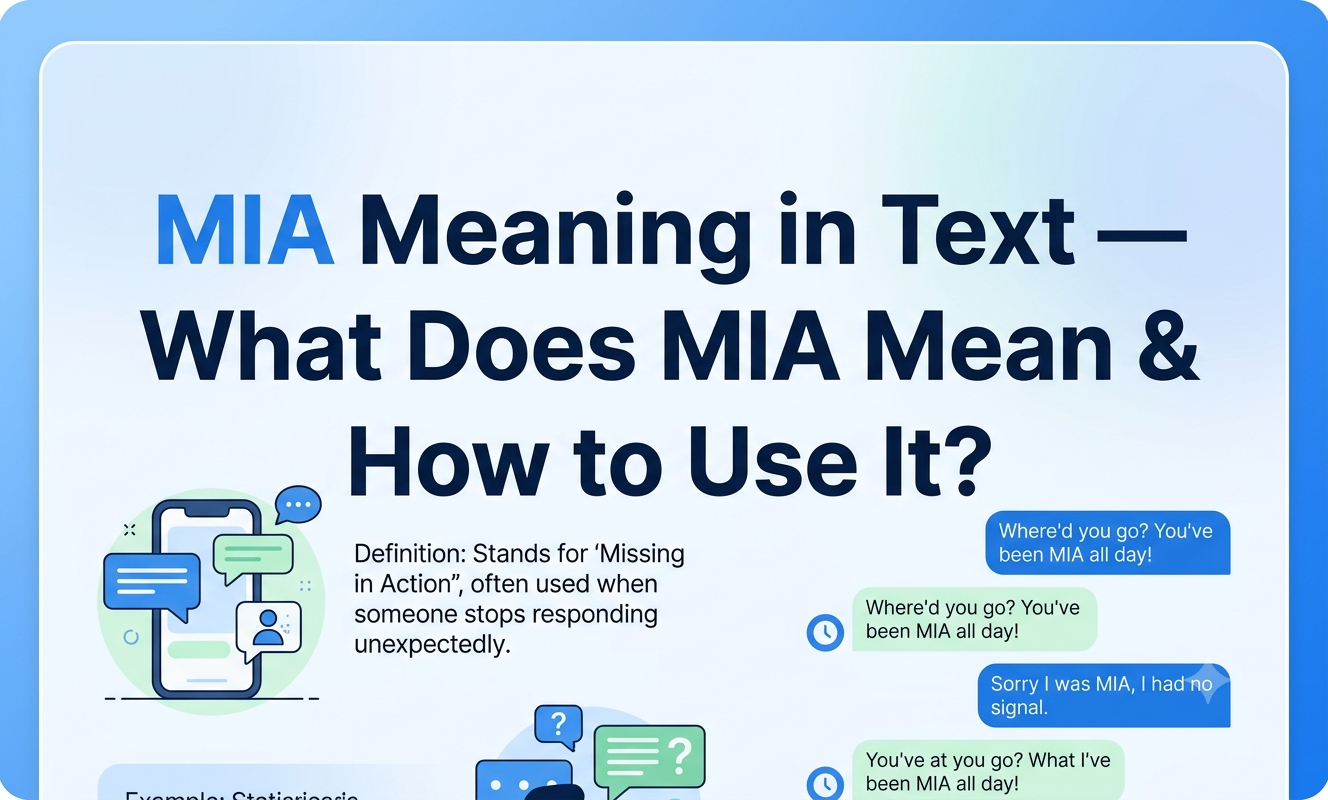
Quick Answer: In texting, MIA stands for “Missing In Action.” It’s used to describe someone who has suddenly gone quiet, stopped replying to messages, or disappeared from a group chat, social media, or plans without explanation. It can be playful (“Where were you? You went MIA!”) or a little annoyed, depending on the tone.
Introduction
You send a text. No reply. A day passes. Still nothing. Then your friend finally texts back: “sorry, I went MIA for a bit.” If you’ve ever wondered what that meant, you’re not alone — MIA meaning in text is one of the most searched texting abbreviations among teens, young adults, and even confused parents trying to keep up.
MIA isn’t new slang. It actually comes from a much older, more serious background, but it’s been fully absorbed into everyday texting culture. In this guide, you’ll learn exactly what MIA means, where it came from, how to use it correctly, whether it’s considered rude, how to reply to it, and which similar terms you might see instead. By the end, you’ll never be confused by a “went MIA” text again.
What Does MIA Mean?
MIA stands for “Missing In Action.” The term originally comes from military language, used to describe a soldier whose whereabouts are unknown during combat — they’re not confirmed dead, just unaccounted for.
Over time, especially through movies, sports commentary, and everyday conversation, MIA moved far outside the military context. By the time texting and social media took off, MIA had become casual slang for anyone who suddenly becomes unreachable, quiet, or absent — whether that’s a friend who stopped texting back, a coworker who skipped a meeting, or a celebrity who disappeared from the public eye for a while.
In 2026, MIA remains one of the most common texting abbreviations across group chats, DMs, and social captions. It’s especially popular in friend group banter, where someone teases another person for disappearing from the conversation, and in relationship texting, where it can carry a slightly more pointed, “why did you ghost me” tone.
MIA Full Form Explained
MIA is a straightforward acronym. Here’s the letter-by-letter breakdown:
| Letter | Stands For |
|---|---|
| M | Missing |
| I | In |
| A | Action |
Put together, MIA = “Missing In Action.” In texting, the “action” part is usually dropped conceptually — people simply mean the person is missing from conversation, plans, or online presence, not literally missing from a physical mission.
How to Use MIA — Real Examples
MIA is flexible. It can be light and funny, genuinely concerned, or a bit passive-aggressive depending on context and tone. Here are examples across different emotional situations:
| Situation | Example | Emotion |
|---|---|---|
| Friend didn’t reply for days | “Bro you went MIA on me 💀” | Playful teasing |
| Group chat member disappeared | “Where’s Sam been? Total MIA energy lately.” | Curious |
| Someone missed a hangout | “You were MIA last night, we missed you!” | Mild disappointment |
| Partner stopped texting back | “You’ve been MIA all day, everything okay?” | Concerned |
| Coworker skipped a call | “He’s been MIA since the meeting started.” | Annoyed |
| Social media break | “She went MIA on Instagram for like a month.” | Observational |
| Reappearing after silence | “Sorry, I’ve been MIA — crazy week.” | Apologetic |
| Friend group inside joke | “Our resident MIA member has returned 🎉” | Humorous |
| Dating app match ghosting | “He matched with me and then went MIA.” | Frustrated |
| Long-lost gaming teammate | “Where’s Jake? He’s been MIA since last season.” | Neutral |
Notice that tone comes from context, not the word itself. A friend saying “you went MIA lol” is joking. A partner saying “you’ve been MIA all week” might genuinely be hurt or worried.
MIA on Different Platforms (2026)
The way MIA gets used shifts slightly depending on the platform. Here’s how it typically shows up in 2026.
On WhatsApp
WhatsApp remains the go-to app for group chats among friends and families, especially outside the U.S. On WhatsApp, MIA usually pops up in family or friend group threads when someone stops responding for an extended period — often paired with a screenshot of unread messages or a “@[name] you’re MIA” tag.
On Snapchat
Snapchat’s whole culture revolves around streaks and quick replies, so going MIA there feels more noticeable. Losing a long Snapstreak because someone “went MIA” is a common complaint in 2026, often shared as a joking or genuinely upset Snap story caption.
On TikTok
On TikTok, MIA shows up less in DMs and more in comment sections and captions, often used humorously — like creators joking they “went MIA” after not posting for a while, or fans commenting “you were MIA, welcome back!” under a creator’s return video.
On Instagram
Instagram sees MIA used in captions, Story replies, and comments, especially when an influencer or friend takes a break from posting. It’s also common in close-friends Stories where someone jokes about being “MIA from the timeline” after a busy period.
Across all platforms, the core meaning stays identical — MIA always signals an unexplained absence — but the tone shifts from playful (TikTok, Snapchat) to slightly more sincere (WhatsApp, Instagram close friends).
Is MIA Rude or Offensive?
MIA is generally not considered rude or offensive. It’s casual slang, and in most everyday texting, it’s used lightly — often as a joke between friends rather than a genuine criticism.
That said, context matters:
- Friendly/neutral use: “You went MIA lol, catch me up!” — this is harmless banter.
- Slightly pointed use: “You’ve been MIA and I’m getting worried” — this expresses real concern, not offense.
- Passive-aggressive use: “Nice of you to finally show up after going MIA” — this can carry sarcasm or irritation, depending on the relationship and prior context.
The word itself isn’t inherently negative. It becomes sharper only when paired with a frustrated tone, punctuation (like extra periods or no emoji), or a pattern of repeated disappearances. Since MIA also has roots in describing missing soldiers, some people prefer to avoid using it in serious or sensitive conversations out of respect for that original meaning — but this isn’t a widespread concern in everyday texting.
How to Reply to MIA
If someone tells you that you (or someone else) went MIA, here are some natural ways to respond:
| Their Message | Your Reply | Tone |
|---|---|---|
| “You went MIA on me!” | “Haha sorry, work has been insane.” | Casual/apologetic |
| “Where have you been, total MIA.” | “I know, I know — phone broke, I’m back now!” | Explaining |
| “You’ve been MIA, everything okay?” | “Yeah, just needed some time offline. I’m good, thank you for checking.” | Reassuring |
| “He’s been MIA since Monday.” | “Let’s give him a call, hope everything’s fine.” | Concerned |
| “Our MIA friend has returned!” | “Miss me? 😂” | Playful |
| “You went MIA on the group chat.” | “Sorry guys, catching up now!” | Group-friendly |
A good rule: match the emotional weight of the message. If it’s a joke, joke back. If it’s genuine concern, respond with reassurance rather than deflecting.
MIA Alternatives and Similar Slang
MIA isn’t the only term for disappearing from conversation. Here are similar words and phrases you might come across:
| Term | Meaning |
|---|---|
| Ghosted | Suddenly cutting off all contact, usually in dating or relationships |
| AFK | “Away From Keyboard” — temporarily unavailable, especially in gaming |
| Left on read | A message was seen but not replied to |
| Radio silence | No communication at all for a period of time |
| Dropped off the map | Similar to MIA, but often implies a longer absence |
| Went dark | Stopped all communication, often intentionally |
| Off the grid | Unreachable, often by choice (e.g., a trip with no signal) |
| Disappeared | General term for someone who stopped being present or responsive |
While these terms overlap, MIA tends to feel the most casual and non-dramatic of the group — it’s rarely used to describe something as serious as ghosting in a breakup, and more often describes short-term, low-stakes absences.
Frequently Asked Questions (FAQ)
Q: What does MIA mean in text? A: MIA means “Missing In Action.” In texting, it describes someone who has suddenly become unreachable, stopped replying, or disappeared from a conversation or social media for a period of time.
Q: Is MIA a military term? A: Yes, originally. MIA was first used to describe soldiers whose location or status was unknown during combat. The texting slang meaning is a casual, non-military adaptation of that original term.
Q: Is MIA the same as ghosting? A: Not exactly. Ghosting usually implies a deliberate, often permanent cutoff of communication, especially in dating. MIA is more casual and often temporary — someone who went MIA usually comes back and explains where they were.
Q: How do you use MIA in a sentence? A: You can use it casually, like “Sorry I’ve been MIA, I was traveling” or about someone else, like “She’s been MIA since the weekend, have you heard from her?”
Q: Is it rude to say someone went MIA? A: Generally no. It’s considered casual slang and is usually said in a joking or lightly concerned tone rather than as an insult.
Q: What’s the difference between MIA and AFK? A: AFK (“Away From Keyboard”) usually describes a short, temporary break, often used in gaming. MIA typically describes a longer, less-explained absence from texting or social media.
Conclusion
Now that you know the MIA meaning in text, you’ll never be confused the next time a friend jokes about someone going “MIA” in the group chat. Rooted in military language but fully adopted by texting culture, MIA is a light, flexible way to describe someone who’s gone quiet — whether that’s for a day, a week, or longer.
Whether you’re using it to tease a friend, check in on a partner, or explain your own disappearance after a busy week, MIA fits naturally into casual conversation across WhatsApp, Snapchat, TikTok, and Instagram. Bookmark this page so you always have a quick reference for MIA and similar texting slang whenever you need it.
Also read WDP Meaning in Text — What Does WDP Mean & How to Use It?
