
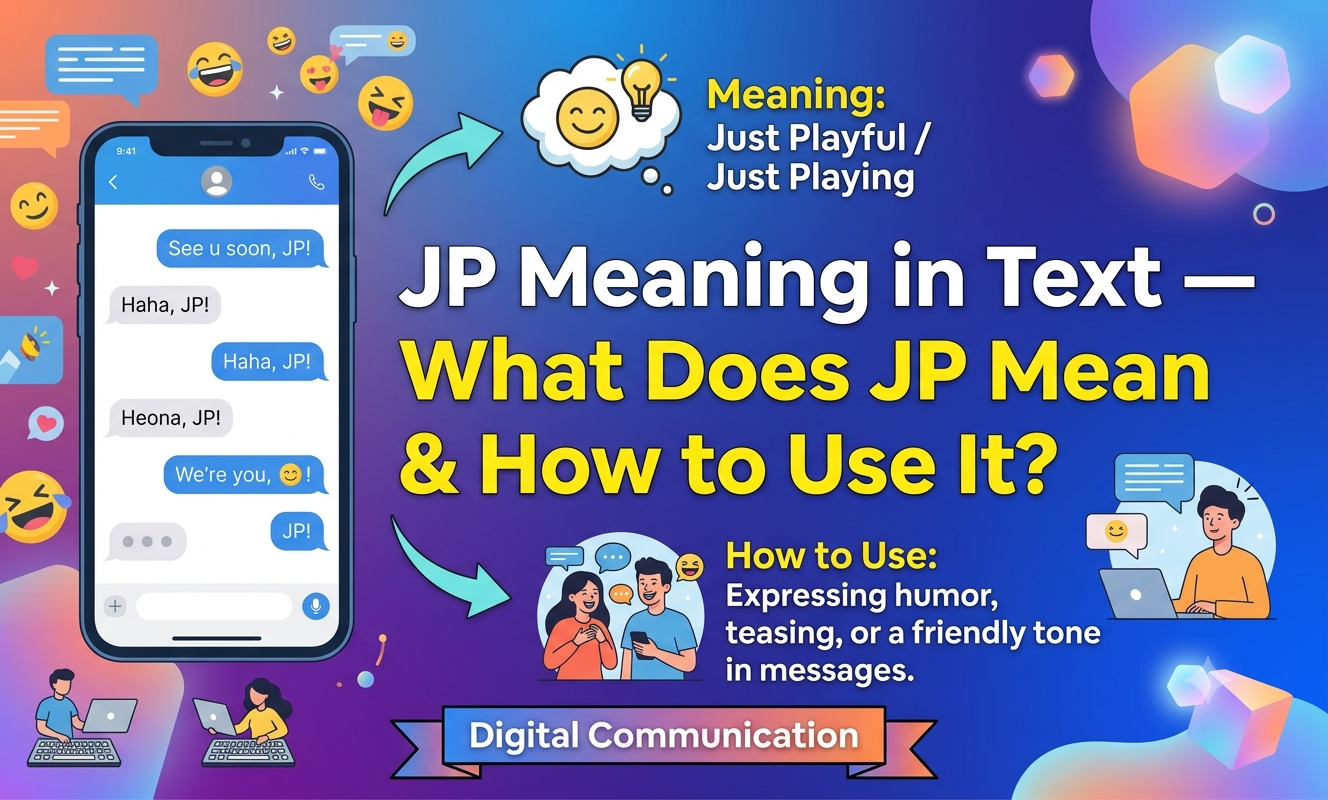
Quick Answer: JP in texting most commonly means “Just Playing” — used right after a joke or sarcastic comment to show you didn’t mean it seriously. Depending on the context, it can also stand for “Just Practicing,” “Just Please,” or someone’s initials. The correct meaning almost always depends on the conversation around it.
Introduction
Ever gotten a text that ended with “jp” and had no idea what it meant? You’re not alone. The jp meaning in text trips up parents, new smartphone users, and even people who text all day but haven’t seen this exact abbreviation before.
Here’s the tricky part: JP isn’t a one-meaning acronym. It shifts depending on who sends it, what platform it’s on, and what came right before it. In this guide, you’ll learn every common meaning of JP, see real examples from 2026 texting culture, find out which platforms use it most, and get ready-made replies you can send back with confidence.
By the end, you won’t just know what does JP mean — you’ll know exactly when and how to use it yourself.
What Does JP Mean?
JP is a texting abbreviation that most commonly stands for “Just Playing.” People type it right after teasing someone, making a sarcastic joke, or saying something that could be taken the wrong way, so the other person knows it wasn’t serious.
Think of it as a lighter, shorter cousin of “jk” (just kidding). Where “jk” tends to follow a joke or a lie, “jp” leans more toward playful teasing between friends — something said in a fun tone rather than to deceive.
JP has floated around group chats and gaming lobbies for years, but usage climbed noticeably through 2025 into 2026 as short, low-effort abbreviations became the norm in fast-paced messaging apps and short-form video comment sections. Younger texters, especially Gen Z and Gen Alpha, favor two- and three-letter abbreviations because they fit quick back-and-forth chats and disappearing-message formats.
Outside of “Just Playing,” JP has a few other meanings that show up depending on context:
- Just Practicing — common in gaming and sports chats, meaning someone wasn’t giving full effort, just warming up.
- Just Please — an informal, slightly softened way to ask for something.
- Someone’s initials — a name shortcut, like texting “call JP” about a friend named John Paul or Jessica Park.
- Job/Position related short forms — occasionally seen in professional or freelance chats, though far less common in casual texting.
Because JP is so short, always read the sentence before and after it. That’s the fastest way to know which meaning applies.
JP Full Form Explained
If JP is being used as an abbreviation (not initials), here’s how each letter typically breaks down:
| Letter | Common Full Form | Context Where It’s Used |
|---|---|---|
| J | Just | Almost always the starting word |
| P | Playing | Most common — teasing, joking, sarcasm |
| P (alt) | Practicing | Gaming, sports, casual competitions |
| P (alt) | Please | Casual requests |
| P (alt) | Person’s name | When used as initials, not slang |
Tip for parents and newer texters: if JP shows up at the end of a sentence, it’s almost always “Just Playing.” If it shows up at the start of a message before a name or request, it’s more likely someone’s initials or “Just Please.”
How to Use JP — Real Examples
Here are real-style examples showing JP in different emotional contexts, so you can see exactly how tone changes its meaning.
| Situation | Example | Emotion |
|---|---|---|
| Teasing a friend | “You really thought that was a good idea 😂 jp jp” | Playful |
| Softening a harsh joke | “Ur cooking is actually terrible, jp love you” | Affectionate teasing |
| Gaming lobby | “Bro I wasn’t even trying, jp round, gimme a sec” | Casual, low-stakes |
| Group chat roast | “Nobody invited you lol jp come through at 7” | Friendly banter |
| Sarcastic comment | “Wow so proud of you for waking up before noon, jp” | Light sarcasm |
| Testing a new joke | “That was so bad it’s good, jp” | Amused |
| After a competitive loss | “You got lucky this time, jp next round’s mine” | Motivated, playful |
| Correcting a rumor | “Nah I wasn’t being serious about quitting, jp” | Reassuring |
| Flirty teasing | “You’re kind of annoying ngl, jp you’re cute tho” | Flirty |
| Calming down a friend | “Chill it was a joke, jp, don’t take it personal” | Reassuring |
JP on Different Platforms (2026)
Slang doesn’t behave the same everywhere. Here’s how JP shows up across the biggest chat and social platforms this year.
On WhatsApp
WhatsApp remains a hub for close friend groups and family chats, so JP here usually softens teasing between people who already know each other well. In 2026, WhatsApp’s continued push toward voice notes and quick-reply stickers means text-based slang like JP often appears in short text bursts sandwiched between voice messages.
On Snapchat
Snapchat’s disappearing message format encourages ultra-short slang, and JP fits right in. Because Snap conversations move fast and messages vanish, users lean on quick abbreviations like JP to keep the pace without over-explaining a joke.
On TikTok
In TikTok comment sections, JP often shows up attached to jokes about a video or a creator, letting commenters poke fun without sounding genuinely critical. With TikTok’s algorithm favoring fast, punchy comments in 2026, short slang like JP performs well because it reads instantly.
On Instagram
On Instagram, JP tends to appear in DMs and comment replies more than captions. It’s common under a friend’s post — a teasing comment followed by “jp” so the joke doesn’t come across as an insult.
2026 Trend Note: Across platforms, teens increasingly pair JP with emojis (😂, 💀, 😭) instead of writing it alone, which softens tone even further and reduces the chance of a joke being misread.
Is JP Rude or Offensive?
JP itself is not rude or offensive — it’s a tone-softener, not an insult. Its whole purpose is to prevent a comment from sounding meaner than intended.
Why some people find it awkward:
- If a joke was genuinely hurtful, adding “jp” afterward doesn’t automatically undo the sting.
- Overusing JP after every comment can come across as someone constantly backpedaling instead of owning their words.
- In professional or unfamiliar settings, casual slang like JP can seem out of place or too informal.
Why it’s usually harmless:
- Between close friends, it’s a normal, lighthearted way to flag a joke.
- It shows the sender cares about how their message lands.
- Context almost always makes the tone clear, especially with an emoji attached.
Bottom line: JP is friendly slang, not an insult — but like any joke, the words before JP matter more than the abbreviation itself.
How to Reply to JP
Not sure how to respond when someone sends you JP? Here are natural reply options.
| Their Message | Your Reply | Tone |
|---|---|---|
| “You’re so slow at replying, jp” | “Lol rude but ok 😂” | Playful acceptance |
| “That outfit is a choice, jp” | “Wow thanks I guess 💀” | Sarcastic humor |
| “Nah you’re actually annoying, jp” | “Love you too” | Warm, unbothered |
| “You’ll never beat my score, jp” | “Watch me 😤” | Competitive, fun |
| “Ur cooking needs work, jp” | “At least I tried lol” | Light-hearted |
| “You always do this, jp” | “Guilty as charged 😂” | Easygoing |
JP Alternatives and Similar Slang
If you want to mix things up or better understand related texting terms, here are similar abbreviations.
| Slang | Meaning |
|---|---|
| JK | Just Kidding |
| JS | Just Saying |
| IJS | I’m Just Saying |
| NGL | Not Gonna Lie |
| TBH | To Be Honest |
| LWK | Low-Key |
| SMH | Shaking My Head |
| FR | For Real |
These terms often appear alongside JP in the same sentence, layering tone (for example: “ngl that was bad, jp”).
Frequently Asked Questions (FAQ)
Q: What does JP mean in text from a girl or guy? A: The meaning doesn’t change based on gender — JP almost always means “Just Playing,” used to show a comment was a joke, regardless of who sends it.
Q: What does JP mean in a text message full form? A: The most common full form of JP in texting is “Just Playing.” Less commonly, it can mean “Just Practicing” or “Just Please” depending on context.
Q: Is JP the same as JK in texting? A: They’re similar but not identical. JK (“Just Kidding”) is often used after a claim or fib, while JP (“Just Playing”) leans more toward teasing or playful jokes between friends.
Q: What does JP mean on Snapchat or TikTok specifically? A: On both platforms, JP carries the same core meaning — “Just Playing” — but it’s used more casually and quickly because of the fast-paced, disappearing, or scroll-heavy nature of these apps.
Q: Can JP mean something other than “Just Playing”? A: Yes. Depending on context, JP can also stand for “Just Practicing,” “Just Please,” or simply someone’s initials, especially in non-slang conversations.
Q: Is it rude to send JP after a joke? A: No, it’s generally seen as considerate — it signals you’re aware the comment could sound harsh and want the other person to know you’re joking.
Conclusion
JP is one of those small texting abbreviations that says a lot once you know the context. Most of the time, the jp meaning in text boils down to “Just Playing” — a quick way to soften a joke or tease a friend without sounding mean. Depending on the conversation, it can also mean “Just Practicing,” “Just Please,” or refer to someone’s initials.
Now that you know how JP works across WhatsApp, Snapchat, TikTok, and Instagram, you’ll never have to guess again when it pops up in your messages. Bookmark this page so you always have a quick reference for JP and other texting slang whenever a new abbreviation catches you off guard.
Also read SMFH Meaning in Text — What Does SMFH Mean & How to Use It in 2026?
