
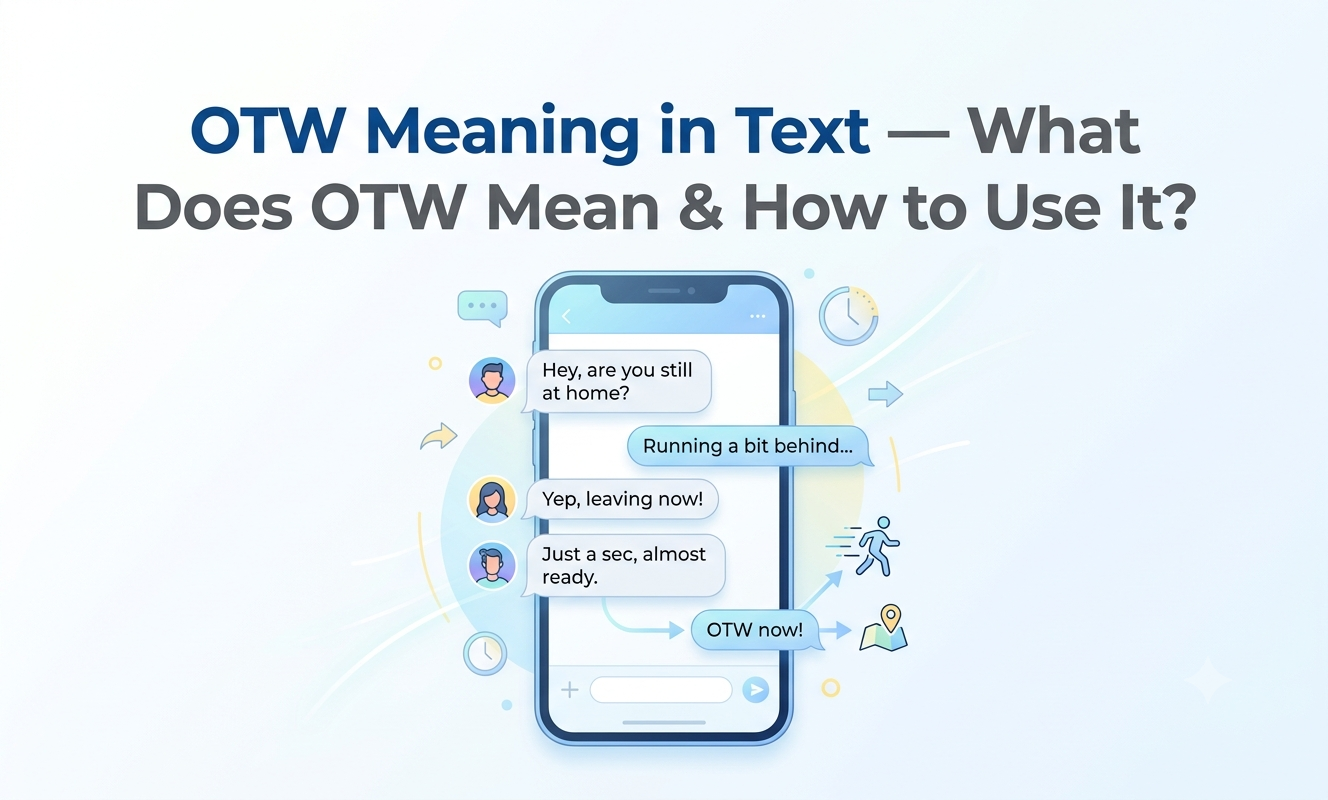
Quick Answer: OTW is a text abbreviation that stands for “On The Way.” People use it to tell someone they have already left and are heading to a location. It’s casual, friendly, and works in almost any messaging app, from group chats to work texts.
Introduction
Someone texts you “leaving now” and you reply with just three letters: OTW. But what does OTW actually mean in text, and is it okay to use it with your boss, your parents, or your crush?
OTW meaning in text is simple — it stands for “On The Way.” It’s one of the most common texting abbreviations used across WhatsApp, Snapchat, TikTok, and Instagram in 2026. People use it to let someone know they’ve started heading somewhere, without typing out a full sentence.
In this article, you’ll learn exactly what OTW means, how it started, how to use it in different situations, whether it’s rude in certain contexts, and what to reply when someone sends it to you. We’ll also cover platform-specific trends and similar slang terms you should know.
What Does OTW Mean?
OTW stands for “On The Way.” It’s used to tell someone that you’ve left your current location and are heading toward a meeting point, event, or destination. Think of it as a quick update that saves you from typing a full sentence.
The abbreviation has been part of internet and texting culture for well over a decade, but its usage has grown significantly with the rise of instant messaging and location-sharing features. In 2026, OTW remains one of the top “status update” abbreviations, alongside terms like BRB and ETA, largely because messaging apps now let people pair OTW with live location pins, making the phrase even more useful in real time.
OTW is considered neutral and casual. It’s not slang tied to a specific age group or platform — it’s used by teens, college students, working professionals, and even parents coordinating school pickups. Its simplicity is exactly why it has stayed popular for so long.
OTW Full Form Explained
Since OTW is an acronym, here’s a simple breakdown of what each letter stands for:
| Letter | Stands For | Purpose |
|---|---|---|
| O | On | Indicates current status/action |
| T | The | Connecting word |
| W | Way | Refers to the route/journey |
Put together, O-T-W = “On The Way” — a short way of saying “I’m currently traveling to where you are” or “I’m heading to the place we agreed on.”
How to Use OTW — Real Examples
OTW can be used in many emotional tones depending on the context — excited, apologetic, urgent, or simply informative. Here are some real-world examples:
| Situation | Example | Emotion |
|---|---|---|
| Meeting a friend | “OTW, be there in 10 mins!” | Excited |
| Running late | “So sorry, OTW now, traffic was bad” | Apologetic |
| Emergency | “OTW to the hospital, call you when I land” | Urgent |
| Work meeting | “OTW to the office, will join the call in 5” | Professional |
| Date night | “Can’t wait to see you, OTW 💕” | Affectionate |
| Group hangout | “OTW guys, save me a seat” | Casual/Friendly |
| Parent pickup | “OTW to get you from practice” | Reassuring |
| Delivery update | “OTW with your order, see you soon” | Informative |
| Concert/event | “OTW to the venue, hyped!!” | Enthusiastic |
| Airport pickup | “Landed, OTW to baggage claim” | Neutral/Practical |
Notice how the same three letters shift tone completely depending on punctuation, emojis, and surrounding words — that’s part of what makes OTW so flexible in everyday texting.
OTW on Different Platforms (2026)
Different apps have slightly different texting cultures, and OTW shows up a bit differently on each one.
On WhatsApp
WhatsApp remains the most common place to see OTW, especially in family and friend group chats. In 2026, WhatsApp’s live location-sharing feature is frequently paired with OTW messages — users type “OTW” and then immediately drop a live pin so the recipient can track their journey in real time.
On Snapchat
On Snapchat, OTW is often combined with Snap Map, where friends can already see each other’s live location. Here, “OTW” functions more like a quick confirmation (“yep, I’m moving”) rather than new information, since the map already shows movement.
On TikTok
On TikTok, OTW shows up less in direct messaging and more in captions and comments — for example, “OTW to try this recipe” or “OTW to becoming that girl.” In this context, it’s used more loosely, describing progress toward a goal rather than physical travel.
On Instagram
On Instagram, OTW appears frequently in DMs and Story replies. It’s also used in caption text for travel or event posts, such as “OTW to the airport ✈️.” Instagram’s 2026 usage trends show OTW being one of the most-used travel-related hashtags in Story stickers, especially among users aged 16–28.
Is OTW Rude or Offensive?
No — OTW is not rude or offensive. It’s a neutral, widely accepted abbreviation used across age groups and social settings.
That said, context matters:
- In casual settings (friends, family, group chats), OTW is completely normal and expected.
- In formal settings (emails, first-time professional contacts, official communication), it’s better to write “I’m on my way” in full, since abbreviations can come across as too casual.
- Overuse without follow-through can be seen as flaky — if you say “OTW” repeatedly but arrive very late, people may find it annoying rather than the abbreviation itself being rude.
In short, OTW itself carries no negative connotation; how and when you use it determines whether it feels appropriate.
How to Reply to OTW
When someone sends you “OTW,” a short, friendly reply is usually all that’s needed. Here are some options depending on the situation:
| Their Message | Your Reply | Tone |
|---|---|---|
| “OTW!” | “Okay, see you soon!” | Friendly |
| “OTW, traffic is bad” | “No worries, take your time” | Reassuring |
| “OTW to the hospital” | “Okay, keep me updated, drive safe” | Concerned |
| “OTW to office” | “Got it, I’ll wait for your call” | Professional |
| “OTW guys!” | “We’re already here, hurry up 😂” | Playful |
| “OTW 💕” | “Can’t wait! 😊” | Affectionate |
OTW Alternatives and Similar Slang
If you want to mix things up, here are similar texting abbreviations with their meanings:
| Abbreviation | Meaning |
|---|---|
| ETA | Estimated Time of Arrival |
| BRB | Be Right Back |
| OMW | On My Way (same meaning as OTW, different phrasing) |
| TTYL | Talk To You Later |
| WYA | Where You At |
| RN | Right Now |
| ASAP | As Soon As Possible |
| GTG | Got To Go |
Note: OMW and OTW are essentially interchangeable — both mean “on the way,” just phrased slightly differently (“On My Way” vs. “On The Way”).
Frequently Asked Questions (FAQ)
Q: What does OTW mean in text? A: OTW means “On The Way.” It’s used to tell someone you’ve left and are currently heading to a location.
Q: What is the full form of OTW? A: The full form of OTW is “On The Way.”
Q: Is OTW the same as OMW? A: Yes, OTW (“On The Way”) and OMW (“On My Way”) mean essentially the same thing and are used interchangeably in texting.
Q: Can I use OTW in a professional text or email? A: It’s fine in quick, informal work texts (like a group chat), but for formal emails or first-time professional contact, it’s better to write the full phrase “I’m on my way.”
Q: Is OTW used only by teens? A: No, OTW is used across all age groups — teens, college students, working adults, and parents all use it in everyday texting.
Q: How do I reply when someone texts me OTW? A: A simple reply like “Okay, see you soon!” or “Take your time” works well, depending on the context.
Conclusion
OTW meaning in text comes down to one simple phrase — “On The Way.” It’s a quick, casual way to update someone on your travel status, and it works across every major messaging platform, from WhatsApp and Snapchat to TikTok and Instagram. Whether you’re running late, heading to a date, or picking up a friend, OTW gets the message across instantly.
Now that you know exactly what OTW means, how to use it, and how to reply to it, you’ll never be confused by a text again. Bookmark this page next time you come across a texting abbreviation you don’t recognize!
Also read SMT Meaning in Text — What Does SMT Mean & How to Use It? (2026 Guide)
