
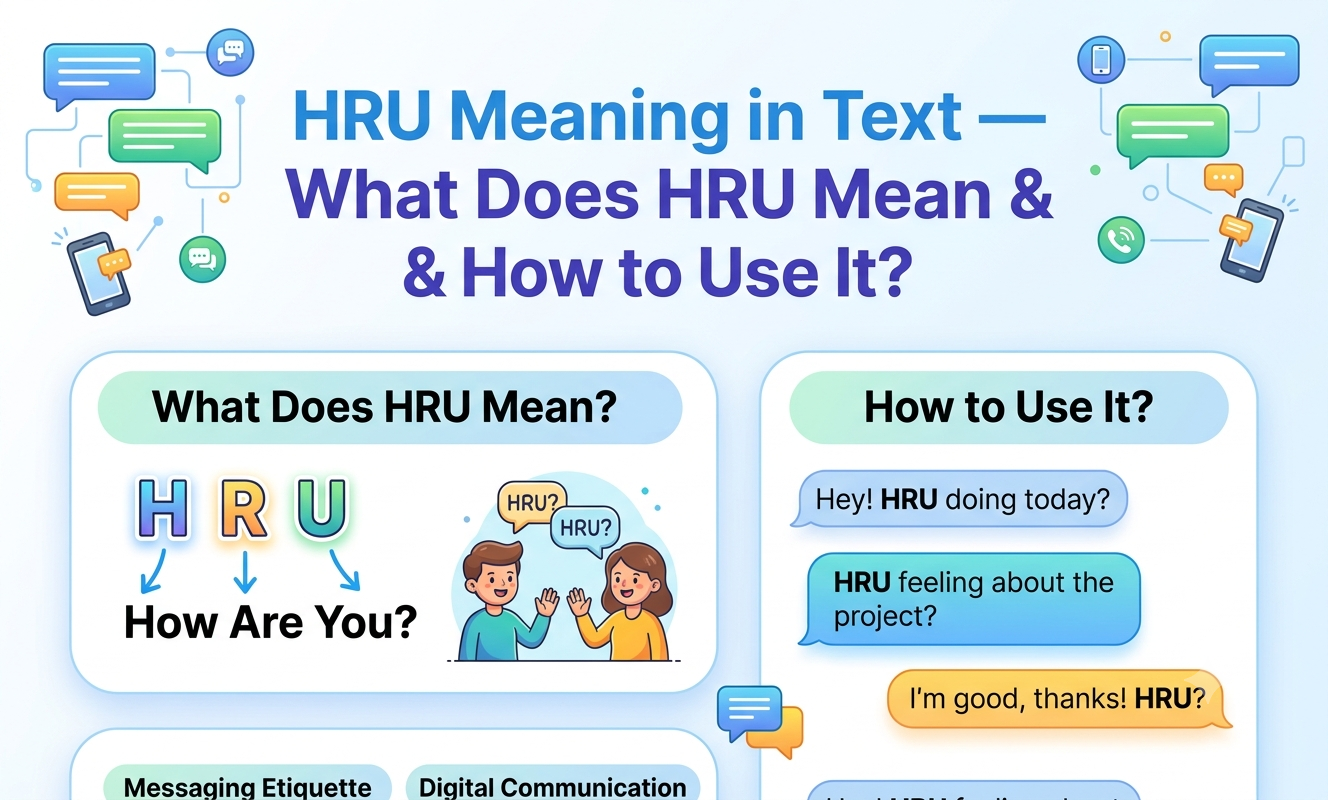
Quick Answer: HRU stands for “How Are You”. It’s a casual texting abbreviation people use to check in on someone quickly, usually at the start or end of a chat. It’s friendly, informal, and works in almost any conversation with friends or family.
Getting a text that just says “hru?” Here’s what it actually means
You’re scrolling through your messages and someone drops a simple “hru” with no context. If you’re a parent, this might look like a typo. If you’re a teen, you probably already know it’s shorthand for something familiar. Either way, you want a straight answer.
The hru meaning in text is simple: it means “How Are You.” It’s one of the most common greetings used in casual texting, especially among younger people who prefer short, quick messages over full sentences.
In this article, you’ll learn what HRU means, where it came from, how to use it in different situations, how it shows up on WhatsApp, Snapchat, TikTok, and Instagram, whether it can come across as rude, and how to reply when someone sends it to you. There’s also a table of similar slang terms and answers to common questions people search for.
What Does HRU Mean?
HRU is a texting abbreviation for “How Are You.” It’s used as a quick, informal check-in, usually sent as a standalone question or tacked onto the end of a message.
This kind of shorthand became common as texting moved from full keyboards to small phone screens, where typing every letter of a sentence took time. Abbreviations like HRU, WYD (what you doing), and TTYL (talk to you later) became a normal part of everyday messaging because they save time without losing meaning.
By 2026, this style of shorthand hasn’t gone away — if anything, it’s become even more embedded in everyday chat culture. Voice-to-text and predictive keyboards have made full sentences easier to type, but short forms like HRU persist because they carry a casual, friendly tone that a full sentence sometimes doesn’t. People use it not just to save keystrokes, but because it signals a relaxed, no-pressure vibe in a conversation.
You’ll typically see HRU used:
- At the start of a conversation, as a greeting
- At the end of a message, after sharing your own update
- In group chats, when checking in on multiple people at once
HRU Full Form Explained
HRU is an initialism, meaning each letter stands for the first letter of a word in the phrase.
| Letter | Stands For |
|---|---|
| H | How |
| R | aRe |
| U | yoU |
Put together, H + R + U = “How Are You.” It’s read exactly the way it’s written — there’s no hidden or alternate meaning behind it, unlike some other texting slang that can have multiple interpretations depending on context.
How to Use HRU — Real Examples
HRU can be used in many different emotional tones depending on the conversation. Below are examples showing how the same three letters can carry very different feelings depending on context.
| Situation | Example | Emotion |
|---|---|---|
| Checking on a friend after bad news | “hey, heard about your exam. hru?” | Concerned |
| Casual daily greeting | “morning! hru today” | Friendly |
| Reconnecting after a while | “omg it’s been so long, hru??” | Excited |
| After sharing your own update | “just got back from the gym, hru?” | Conversational |
| Checking in during a tough time | “hru holding up after everything” | Caring |
| Texting a crush | “hey stranger, hru 👀” | Flirty |
| Group chat check-in | “hru guys, haven’t heard from anyone in days” | Curious |
| After an argument | “hru… still mad at me?” | Nervous |
| Late night text | “can’t sleep, hru rn” | Reflective |
| Professional-casual context (close coworker) | “long day, hru holding up” | Supportive |
Notice how the same word changes meaning depending on the punctuation, emojis, and the message around it. A simple “hru” with a question mark reads differently than “hru??” with two question marks, which usually signals more urgency or emotional weight.
HRU on Different Platforms (2026)
Texting slang doesn’t behave the same way everywhere. Each platform has its own texting culture, and HRU shows up a little differently depending on where you’re chatting.
On WhatsApp
WhatsApp remains one of the most popular messaging apps globally for both personal and family communication, and HRU is commonly used here as a simple daily check-in, especially in one-on-one chats and family groups. Because WhatsApp conversations often stretch across days, HRU is frequently used to restart a conversation that’s gone quiet.
On Snapchat
On Snapchat, HRU tends to appear inside Snap captions or chat messages, often paired with a selfie or a quick photo. Since Snapchat conversations are built around fast, visual exchanges, HRU works as a quick caption rather than a full sentence — it fits the platform’s fast-paced, disappearing-message style.
On TikTok
On TikTok, HRU shows up less as a greeting and more in comment sections, where users check in on creators or friends after an emotional or personal video. It’s also used in duet or stitch captions when someone is reacting to another person’s content.
On Instagram
On Instagram, HRU is common in DMs and story replies. It’s often the first message someone sends after viewing another person’s story, functioning as a low-pressure way to start a conversation without needing a long opener.
Across all these platforms, the core meaning stays the same — only the context and tone shift slightly based on how each app is typically used.
Is HRU Rude or Offensive?
HRU itself is not rude or offensive. It’s simply a shortened, casual way of asking someone how they are doing. Millions of people use it every day without any negative intent.
That said, context matters:
- When it can feel dismissive: If someone sends “hru” as a one-word reply to a long, emotional message you just shared, it can come across as low-effort or dismissive, since it doesn’t acknowledge what you said.
- When it feels perfectly normal: In casual daily chats, group texts, or as an opener to a conversation, HRU is completely normal and expected.
The tone usually depends on what came before and after the message, not the abbreviation itself. If you’re unsure how someone will take it, adding a bit more context (“hru, saw your post and wanted to check in”) softens it and shows you’re genuinely asking.
How to Reply to HRU
Replying to “hru” doesn’t need to be complicated, but the right response depends on how you’re actually feeling and how much detail you want to share.
| Their Message | Your Reply | Tone |
|---|---|---|
| “hru?” | “good, just chilling. hru?” | Casual |
| “hru?” | “not great tbh, rough day” | Honest |
| “hru today” | “busy busy but doing okay! u?” | Upbeat |
| “hru holding up” | “getting there, thanks for checking” | Grateful |
| “hru rn” | “can’t complain, wbu” | Relaxed |
| “hru??” | “I’m good! why, everything okay?” | Curious |
A good rule of thumb: match their energy. If they sent a caring “hru” after tough news, a short “I’m okay” plus a thank-you keeps the tone genuine.
HRU Alternatives and Similar Slang
HRU isn’t the only shorthand used to check in on someone. Here are other common terms with similar or related meanings.
| Slang | Meaning |
|---|---|
| WYD | What You Doing |
| WBU | What About You |
| SUP | What’s Up |
| HBU | How Bout You |
| WYA | Where You At |
| TTYL | Talk To You Later |
| NM | Not Much |
| HMU | Hit Me Up |
These terms often appear together in the same conversation. For example, someone might text “hru? wbu?” in the same message, combining two check-in phrases for a fuller question.
Frequently Asked Questions (FAQ)
Q: What does HRU mean in text? A: HRU means “How Are You.” It’s a short, casual way of checking in on someone over text.
Q: Is HRU the same as WBU? A: Not exactly. HRU means “How Are You,” while WBU means “What About You.” HRU usually opens a conversation, while WBU is often used to turn a question back on someone after answering it yourself.
Q: Is it okay to reply to HRU with just “good”? A: Yes, a short reply like “good” or “good, u?” is completely normal for casual texting. It’s only worth adding more detail if you want to share how you’re really doing.
Q: Why do teens use HRU instead of typing the full question? A: It’s faster to type and fits the casual, quick-paced style of texting that’s common among teens. It also signals a relaxed, informal tone.
Q: Does HRU mean something different on Snapchat or TikTok? A: No, the meaning stays the same everywhere. Only the context in which it’s used — like a Snap caption versus a comment — changes slightly.
Q: Can HRU be used in a flirty or romantic way? A: Yes, depending on the emojis, punctuation, or timing (like a late-night text), HRU can carry a flirty or affectionate tone rather than a purely casual one.
Wrapping Up
HRU is a simple, harmless piece of texting shorthand that means “How Are You.” Whether it shows up in a WhatsApp chat, a Snapchat caption, or an Instagram DM, the meaning stays the same — someone is casually checking in on you.
Context, punctuation, and the conversation around it shape whether it feels caring, casual, or even flirty. Now that you know the full meaning, the platform trends, and how to reply, you’ll never have to guess what “hru” means again.
Bookmark this page so you can quickly check back anytime a text abbreviation leaves you scratching your head.
Also read IMK Meaning in Text — What Does IMK Mean & How to Use It?
