
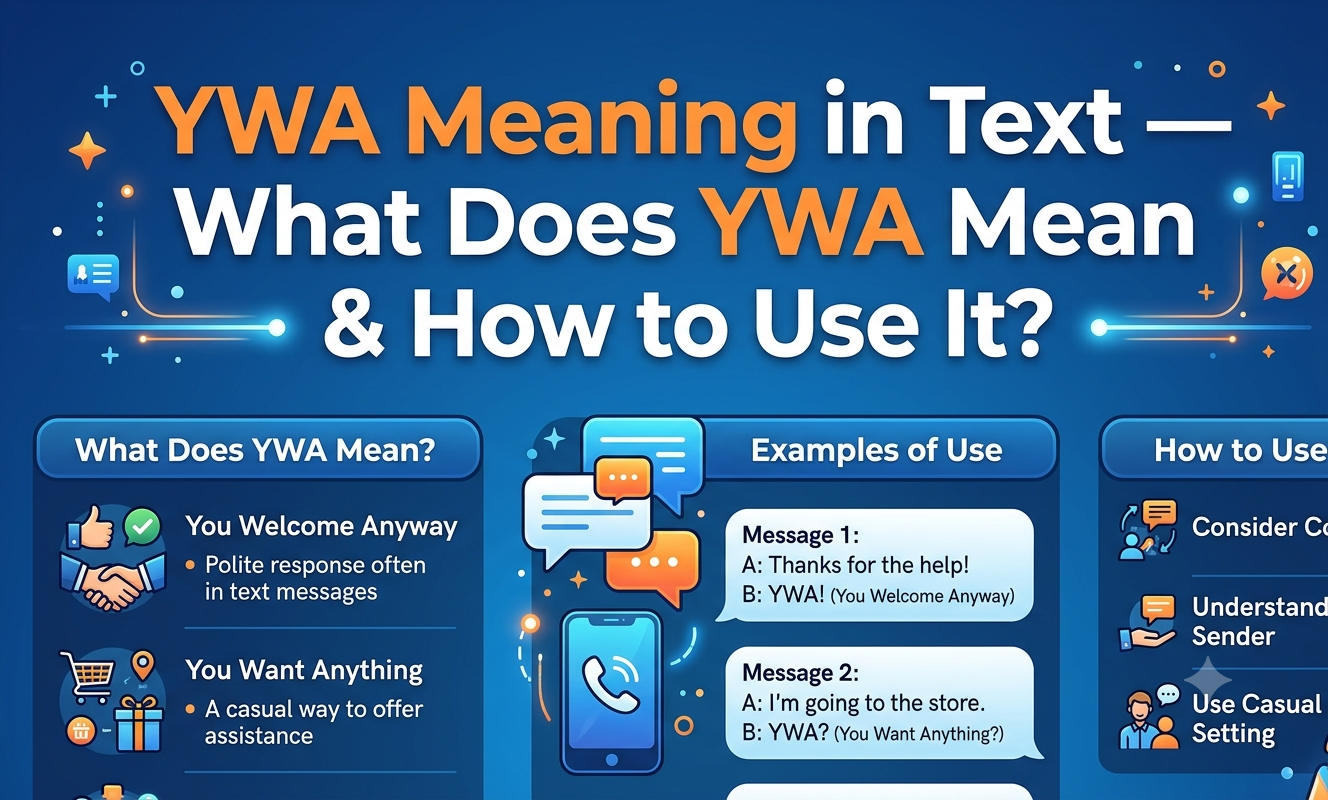
YWA meaning in text: YWA stands for “You’re Welcome Anyway.” People send it when they did something nice for someone who forgot to say thank you. It is usually playful or lightly sarcastic, and it works like a gentle reminder that a “thanks” was expected.
You held the door, sent the notes, or shared that meme your friend asked for. Then… nothing. No “thanks,” no emoji, just silence. A few minutes later, you type three letters: YWA.
If you have ever received that message and wondered what it means, you are in the right place. The YWA meaning in text is simple once you know it, but the tone behind it can change a lot depending on who sends it and why.
In this guide, you will learn:
- What YWA stands for and where it came from
- How to use YWA with 10 real examples in different moods
- How YWA is used on WhatsApp, Snapchat, TikTok, and Instagram in 2026
- Whether YWA is rude or just funny
- The best ways to reply to YWA
- Similar slang terms you might see next to it
This guide is written for teens who want to use YWA the right way, and for parents who just want to understand what their kids are typing. Let’s break it down.
What Does YWA Mean in Text?
YWA means “You’re Welcome Anyway.” It is a short way of saying, “I helped you, you didn’t thank me, but I’ll accept the thanks you never sent.”
The key word is “anyway.” A normal “you’re welcome” comes after someone says thank you. YWA comes when the thank you is missing. That is why it often carries a teasing or slightly sarcastic tone.
Where did YWA come from?
YWA grew out of the much older abbreviation YW (“You’re Welcome”), which has been common in texting and online chat since the early 2000s. People simply added the “A” for “anyway” to turn a polite reply into a playful jab.
The spoken phrase “you’re welcome anyway” has been around for a long time. Think of a parent saying it to a kid who grabbed a snack and walked off. The texting version spread through group chats and social media comments, where short, punchy replies get the most reactions.
Why YWA is popular in 2026
In 2026, YWA is part of a bigger trend: short replies that carry a mood, not just a meaning. Teens and young adults prefer three-letter replies that sound casual and a little cheeky.
YWA shows up most in:
- Group chats where someone shares answers, links, or plans
- Snapchat and Instagram DMs after sending a funny post or reel
- TikTok comments under helpful “life hack” or tutorial videos
- Gaming chats after one player helps another win
It is not as common as LOL or IDK, but it is widely understood among people who text a lot.
YWA Full Form Explained
The YWA full form is easy to break down. Each letter stands for one word:
| Letter | Word | What it adds |
|---|---|---|
| Y | You’re | Points at the person being spoken to |
| W | Welcome | The polite response to thanks |
| A | Anyway | Shows that no thanks was given |
Put together, YWA = You’re Welcome Anyway.
Quick tip: YWA can be written in capitals (YWA) or lowercase (ywa). The meaning stays the same. Lowercase usually looks more relaxed, while capitals can feel a bit louder or more pointed.
Other meanings of YWA
In texting slang, YWA almost always means “You’re Welcome Anyway.” In rare cases, it may be a typo for YW or a name or brand abbreviation. If the message is about thanks or help, you can be confident it means “You’re Welcome Anyway.”
How to Use YWA in Texting — Real Examples
Now that you know the YWA full form, let’s see how it works in real chats. The same three letters can sound funny, annoyed, sweet, or sarcastic depending on the situation.
| Situation | Example | Emotion |
|---|---|---|
| Sent homework answers, no reply | “Sent you all 10 answers… ywa 🙄” | Mild annoyance |
| Shared a funny meme, friend just laughed | Friend: “LMAOOO” / You: “ywa” | Playful teasing |
| Gave a ride, friend got out without a word | “Glad you got home safe. YWA 😂” | Light sarcasm |
| Fixed a sibling’s phone settings | “Your WiFi works now. YWA” | Proud, jokey |
| Recommended a show they now love | Friend: “This show is SO good” / You: “ywa, told you” | Smug but friendly |
| Covered a coworker’s shift | “Took your Saturday shift. YWA lol” | Friendly reminder |
| Tagged a friend in a giveaway they won | “You won?? ywa bestie 💅” | Excited, cheeky |
| Sent a long, helpful voice note, got “k” | “k?? ok ywa I guess” | Genuinely hurt |
| Partner forgot to thank you for dinner | “Dinner was made with love. YWA ❤️” | Sweet and teasing |
| Gaming teammate you saved left the match | “Carried you that whole round. YWA” | Competitive humor |
Tips for using YWA the right way
- Use it with people who know you. Friends and family will usually read it as a joke.
- Add an emoji to set the tone. A 😂 or 😜 keeps it light. A 🙄 makes it sound annoyed.
- Don’t use it at work with managers, teachers, or clients. It can seem passive-aggressive.
- Don’t overuse it. If you send YWA every time, people may feel you expect constant praise.
In short, YWA works best as a friendly nudge, not a complaint.
YWA on Different Platforms (2026)
The YWA meaning in text stays the same everywhere, but the way people use it changes a little from app to app. Here is how YWA shows up on the biggest platforms in 2026.
YWA on WhatsApp
WhatsApp is still the main messaging app for families, friend groups, and even workplaces in many countries. Because of that, YWA on WhatsApp is usually gentle and family-friendly.
Common WhatsApp uses:
- A cousin shares a recipe or a document and gets no reply
- Someone sends the group trip plan and only gets “seen” ticks
- A parent forwards a useful tip and a teen replies with an emoji only
Example: “Added everyone’s tickets to the group. YWA 😌”
Since WhatsApp group chats often mix ages, YWA here is mostly a soft joke. Older family members may not know it, so you may need to explain it once.
YWA on Snapchat
Snapchat is where YWA feels most at home. Snap chats are fast, casual, and full of slang, and many users chat mainly with close friends.
On Snapchat, people use YWA when:
- They send a funny snap and the friend opens it without replying
- They remind someone about a test, birthday, or plan
- They keep a streak alive for a friend
Example: “Saved our 200-day streak while you slept. ywa”
On Snapchat, YWA is almost always playful. Friends use it to tease each other, not to start a fight.
YWA on TikTok
On TikTok, YWA appears mostly in comments and captions, not private chats. Creators who share hacks, tutorials, or tips often use it in a confident, joking way.
You might see:
- A caption like “The study trick nobody told you about. YWA”
- A creator replying to comments with “ywa 🫡”
- Duets and stitches where someone “solves” a problem and ends with YWA
In 2026, short-form video keeps driving how slang spreads. A term that trends in TikTok comments often moves into private chats within weeks, and YWA is a good example of that cycle.
YWA on Instagram
On Instagram, YWA shows up in DMs, story replies, and comments. A big trigger is sharing reels. People send dozens of reels a day to friends, and many go unanswered.
Common Instagram uses:
- After sending a reel your friend laughs at later
- In a caption for a helpful carousel post
- When someone uses your outfit, café, or travel tip without credit
Example: “You finally watched the reel I sent 3 days ago? ywa 😂”
On Instagram, YWA can lean slightly more sarcastic, because unanswered DMs are such a common frustration.
Is YWA Rude or Offensive?
The honest answer: YWA is not offensive, but it can feel rude in the wrong setting. It has no swear words or hidden meaning. The risk is all about tone.
When YWA is harmless and funny
- Between close friends who joke with each other all the time
- When paired with a laughing or winking emoji
- When the “missing thanks” was small, like a meme or a link
- When both people clearly know it is a joke
Here, YWA is just playful teasing. Most friends will laugh and send a “THANK YOU 😭” right back.
When YWA can come across as rude
- With teachers, bosses, or clients, where it sounds passive-aggressive
- When the other person is busy, upset, or going through something
- When it is sent with an eye-roll emoji or after a long silence
- When you use it every single time someone forgets to say thanks
In these cases, the other person may feel called out or guilty.
A note for parents
If you see YWA on your child’s phone, there is nothing to worry about. It is a normal, harmless texting phrase. At most, it shows that your child helped someone and wanted a little credit for it. If you see it a lot in one chat, it might simply mean a friend often forgets to say thanks.
Bottom line: YWA is safe slang. Use it with people who share your sense of humor, and skip it in formal chats.
How to Reply to YWA
Got a YWA? Don’t panic. In most cases, the sender just wants a quick thank you. Here are some easy replies for different moods:
| Your mood | Reply example | When to use it |
|---|---|---|
| Apologetic | “Omg sorry, THANK YOU so much! 🙏” | You really did forget to say thanks |
| Playful | “I was getting to it 😂 ty ty ty” | Joking with a close friend |
| Sarcastic back | “Wow, so humble. Thanks I guess 🙄😂” | Friendly banter between besties |
| Sweet | “You’re the best, I owe you one ❤️” | Partner, sibling, or best friend |
| Explaining | “Sorry, I was in class! Thanks a lot” | You were genuinely busy |
| Returning the favor | “Thanks! Coffee’s on me next time ☕” | They did something big for you |
Tip: A short “ty” (thank you) or “tysm” (thank you so much) is usually all it takes to clear the air.
YWA Alternatives and Similar Slang
YWA belongs to a family of “thanks and welcome” slang. If you want a different tone, or you see these terms next to YWA, here is what they mean:
| Slang | Full form | Meaning and tone |
|---|---|---|
| YW | You’re Welcome | Plain, polite reply after someone says thanks |
| NP | No Problem | Casual, relaxed way to accept thanks |
| YWW | You’re Welcome Welcome | Extra-friendly, cute version of YW |
| MP | My Pleasure | Warm and a little more polite |
| ANYTIME | — | Friendly, shows you’d happily help again |
| TY / TYSM | Thank You / Thank You So Much | The reply YWA is usually fishing for |
| NBD | No Big Deal | Downplays the favor, very chill |
| IGY | I Got You | Supportive, “I’ve got your back” energy |
YWA vs YW: what’s the difference?
This is the most common mix-up:
- YW is used after someone says thank you. It is purely polite.
- YWA is used when no thank you came. It adds a teasing or sarcastic edge.
So if your friend says “thanks!” reply with YW. If they say nothing at all, YWA is the cheeky option.
Frequently Asked Questions (FAQ)
Q: What does YWA mean in text?
A: YWA means “You’re Welcome Anyway.” People send it after doing something helpful for someone who didn’t say thank you. It is usually playful, but it can sound sarcastic depending on the tone.
Q: What is the full form of YWA?
A: The YWA full form is “You’re Welcome Anyway.” Y stands for You’re, W for Welcome, and A for Anyway.
Q: What does YWA mean on Snapchat?
A: On Snapchat, YWA has the same meaning: “You’re Welcome Anyway.” Friends often use it after sending a funny snap, saving a streak, or reminding someone about plans without getting a thanks.
Q: Is YWA rude?
A: YWA is not rude by itself. With close friends, it is a lighthearted joke. With teachers, bosses, or people you don’t know well, it can come across as passive-aggressive, so it’s best to avoid it there.
Q: What is the difference between YW and YWA?
A: YW (“You’re Welcome”) is a polite reply after someone thanks you. YWA (“You’re Welcome Anyway”) is used when the person forgot to thank you, so it adds a teasing tone.
Q: How should I reply to YWA?
A: The easiest reply is a quick thank you, like “ty!” or “thank you so much 😭.” With close friends, you can also joke back, for example: “I was literally about to say thanks 😂.”
Q: Should parents worry if their child uses YWA?
A: No. YWA is harmless texting slang with no hidden or inappropriate meaning. It simply shows your child helped someone and wanted a little credit.
Q: Can YWA be written in lowercase?
A: Yes. “ywa” and “YWA” mean the same thing. Lowercase feels more casual, while all caps can feel more pointed.
Final Thoughts
Now you know the YWA meaning in text: it stands for “You’re Welcome Anyway,” a cheeky way to point out that someone forgot to say thanks. It started as a twist on the classic YW and is now common across WhatsApp, Snapchat, TikTok, and Instagram in 2026.
Use YWA with friends who get your humor, add an emoji to keep the tone light, and skip it in formal chats. If someone sends it to you, a quick “ty” usually fixes everything.
Found this helpful? Bookmark this page and share it with a friend who still thinks YWA is a typo. And hey, if this guide cleared things up for you… YWA. 😉
Also read WFH Meaning in Text — What Does WFH Mean & How to Use It?

1 Comment
Pingback: OC Meaning in Text: What Does OC Mean & How to Use It?