
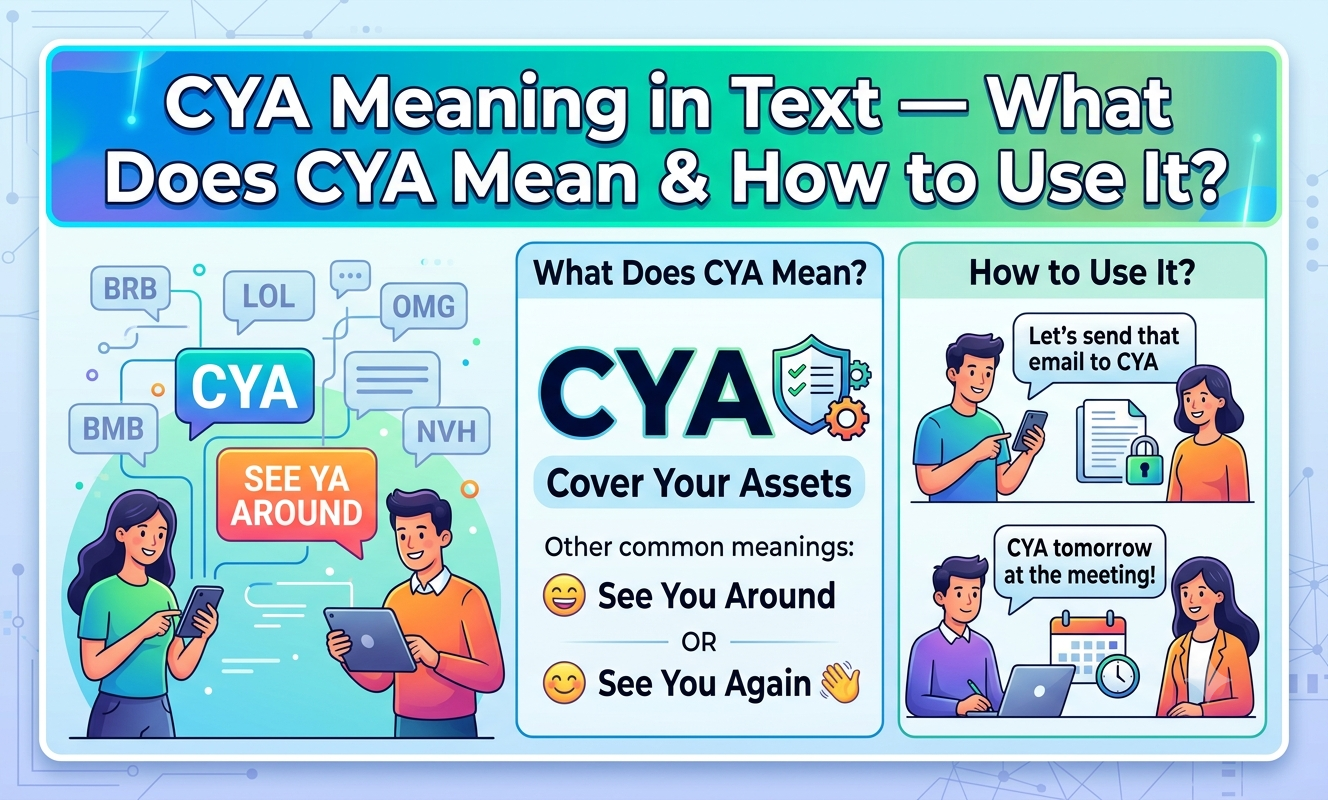
Quick Answer: CYA in texting means “See Ya” — a short, casual way of saying goodbye. It’s used at the end of a conversation to sign off in a friendly, low-key way, often between friends, classmates, or coworkers who know each other well.
Introduction
Ever gotten a text that just says “cya” and wondered if the person is annoyed, in a rush, or just being casual? You’re not alone. CYA meaning in text is one of those small abbreviations that shows up everywhere — group chats, DMs, work Slack messages — but rarely gets explained.
In this guide, you’ll learn exactly what CYA means, where it came from, how to use it naturally, and how it shows up differently across WhatsApp, Snapchat, TikTok, and Instagram in 2026. We’ll also cover whether it can come across as rude, how to reply to it, and similar slang terms you’ll want in your back pocket.
By the end, you’ll never have to second-guess a “cya” text again.
What Does CYA Mean?
CYA stands for “See Ya”, a shortened, informal way of saying goodbye in text messages, chats, and social media comments. It’s the digital equivalent of waving and saying “catch you later” instead of a formal “goodbye.”
CYA has been part of internet slang since the early days of instant messaging platforms like AIM and MSN Messenger in the late 1990s and early 2000s. It resurfaced heavily with SMS texting in the 2000s and has stayed a staple ever since because it’s fast, casual, and easy to type on any keyboard.
By 2026, CYA remains one of the most common sign-off abbreviations used across messaging apps, especially among Gen Z and younger millennials who favor short, low-effort goodbyes over full sentences. Language trend reports from social platforms continue to show that shortened farewells like CYA, TTYL, and BRB rank among the top casual sign-offs used daily in group chats.
It’s worth noting CYA also has a completely unrelated meaning in professional or legal contexts — “Cover Your Ass” — used when someone documents something to protect themselves from blame. Context always determines which meaning applies, but in casual texting between friends, CYA almost always means “See Ya.”
CYA Full Form Explained
Since CYA is a phonetic abbreviation (based on how the words sound, not just their first letters), here’s how it breaks down:
| Letter | Represents | Sound |
|---|---|---|
| C | “See” | Sounds like the letter C |
| Y | “Ya” (casual for “you”) | Sounds like the letter Y |
| A | “Ya” (continued — completes “you”) | Blended into the sound |
Unlike acronyms such as LOL or BRB, CYA isn’t built from the first letter of each word. Instead, it mimics the phonetic sound of saying “See ya” quickly out loud — which is why it’s called a phonetic abbreviation rather than a true acronym.
How to Use CYA — Real Examples
CYA works in almost any casual conversation, but tone and context change how it feels. Here are examples across different emotional situations:
| Situation | Example | Emotion |
|---|---|---|
| Ending a casual chat | “Alright, cya!” | Friendly |
| Leaving school/work | “Heading out now, cya tomorrow” | Neutral |
| Quick goodbye mid-task | “Gtg, cya” | Rushed |
| After hanging out | “Had fun today, cya soon!” | Warm |
| Ending an argument | “Whatever, cya.” | Annoyed/cold |
| Before a trip | “Cya in two weeks!” | Excited |
| Casual sign-off in group chat | “Ok cool, cya guys” | Relaxed |
| Ending a call/video chat | “Alright cya, love you” | Affectionate |
| Sarcastic dismissal | “Sure, cya then 🙄” | Sarcastic |
| Professional-casual (coworkers) | “Cya at the meeting tomorrow” | Neutral/friendly |
Notice how the same three letters can feel completely different depending on punctuation, emojis, and the words around them. A period after “cya” often reads as colder, while an exclamation mark or emoji softens it.
CYA on Different Platforms (2026)
How CYA is used can shift slightly depending on the app. Here’s how it plays out across major platforms this year.
On WhatsApp
WhatsApp remains the go-to app for both casual friend groups and family chats. CYA on WhatsApp is often paired with a wave emoji 👋 or a quick voice note. Since WhatsApp is widely used across all age groups, CYA here tends to be more universally understood, even by parents and older relatives.
On Snapchat
Snapchat’s fast, disappearing-message culture makes CYA a natural fit. It’s frequently used to end a Snap chat streak conversation for the day, often shortened even further in Snapchat’s autocomplete-heavy texting style. Streak-focused conversations in 2026 continue to favor ultra-short sign-offs like CYA to keep exchanges quick.
On TikTok
On TikTok, CYA shows up less in DMs and more in comment sections — usually as a playful sign-off after a joke exchange or a “see you in the next video” type comment. Creators sometimes use it in captions to casually close out a video series.
On Instagram
Instagram DMs and comments use CYA similarly to Snapchat — quick, casual, and often followed by an emoji. It’s especially common in close friend story replies, where brevity is the norm.
Across all platforms in 2026, the trend is the same: shorter is better, and CYA fits perfectly into a texting culture that favors speed over formality.
Is CYA Rude or Offensive?
CYA is not inherently rude or offensive — but tone and context matter a lot.
Why it can seem rude:
- Sent abruptly with no punctuation or emoji, it can feel dismissive.
- Used right after a disagreement, it can come across as cold or passive-aggressive.
- In a formal or professional setting, it may seem too casual.
Why it’s usually fine:
- Between friends, it’s simply a normal, friendly goodbye.
- It saves time and matches the fast pace of everyday texting.
- Adding an emoji, exclamation point, or extra word (“cya soon!”) almost always removes any negative tone.
The general rule: if the conversation before it was friendly, CYA is friendly too. If the conversation was tense, CYA can carry that tension with it.
How to Reply to CYA
Not sure how to respond when someone texts you “cya”? Here are natural replies for different situations:
| Their Message | Your Reply | Tone |
|---|---|---|
| “Cya!” | “Cya! 👋” | Friendly mirror |
| “Cya tomorrow” | “Sounds good, see you then!” | Warm confirmation |
| “Cya.” (short, no emoji) | “Ok, take care!” | Neutral/kind |
| “Cya guys” (group chat) | “Bye everyone!” | Group-friendly |
| “Cya soon 😊” | “Can’t wait, cya!” | Enthusiastic |
| “Whatever, cya” (after tension) | “Hey, let’s talk later, ok?” | De-escalating |
Matching their energy usually works best — a casual “cya” deserves a casual reply, while a cold one might need a warmer response to smooth things over.
CYA Alternatives and Similar Slang
CYA isn’t the only casual goodbye floating around in texts. Here are similar terms you’ll often see alongside it:
| Term | Meaning |
|---|---|
| TTYL | Talk To You Later |
| BRB | Be Right Back |
| G2G / GTG | Got To Go |
| L8R | Later |
| PCM | Please Call Me |
| CU | See You (shorter version of CYA) |
| BBL | Be Back Later |
| OOO | Out Of Office (more professional context) |
These terms often appear together in the same conversation — for example, “gtg, cya l8r” is a completely normal sentence in casual texting.
Frequently Asked Questions (FAQ)
Q: What does CYA mean in text from a girl or guy? A: CYA means the same thing regardless of who sends it — it simply means “See Ya,” a casual way of saying goodbye. There’s no different meaning based on gender.
Q: What does CYA mean in a work or professional context? A: In professional settings, CYA sometimes means “Cover Your Ass” — referring to documenting actions or decisions to avoid blame later. Context makes it clear which meaning is intended.
Q: Is CYA the same as goodbye? A: Yes, CYA is essentially a shortened, informal version of “goodbye” or “see you later,” commonly used in texting and casual chats.
Q: What’s the difference between CYA and CU in texting? A: Both mean “See You,” but CU is even shorter. CYA is slightly more common in everyday texting, while CU is often used for extra brevity.
Q: Can CYA be used in formal emails or messages? A: It’s best to avoid CYA in formal emails, since it’s considered informal internet slang. Stick to “Goodbye” or “Best regards” in professional writing instead.
Q: Why do people use CYA instead of typing “see you”? A: CYA saves time and keystrokes, matching the fast, casual style of modern texting where brevity is valued over full sentences.
Conclusion
CYA meaning in text boils down to a simple, friendly way of saying “See Ya” — a quick sign-off used across WhatsApp, Snapchat, TikTok, and Instagram in 2026. While it can occasionally feel cold depending on tone, it’s almost always meant as a casual, everyday goodbye between friends, classmates, or coworkers.
Now that you know what CYA means, how to use it, and how to reply to it naturally, you’ll never have to guess again the next time it pops up in your messages. Bookmark this page so you always have a quick reference for CYA and its related slang terms.
Also read TY Meaning in Text — What Does TY Mean & How to Use It?
