
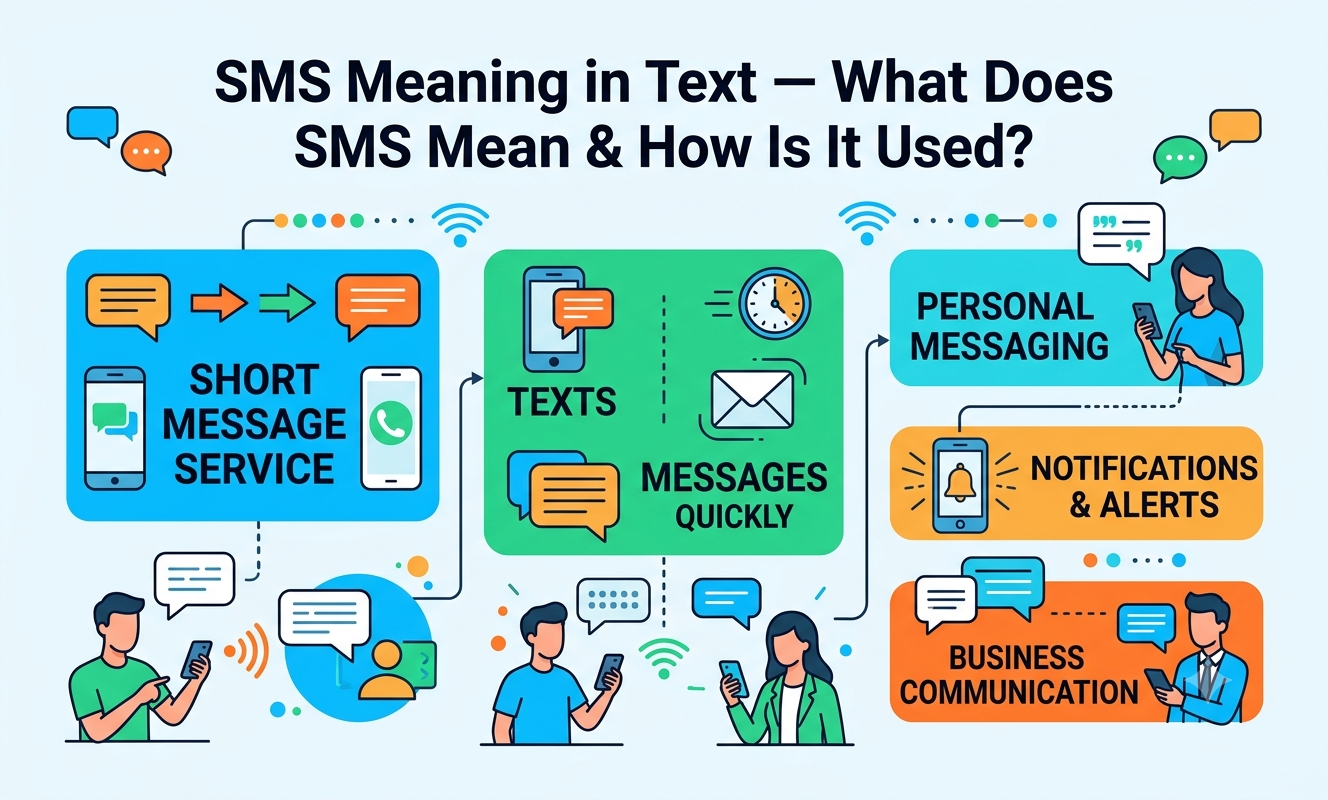
Quick Answer: SMS stands for Short Message Service. It’s the basic text-messaging feature built into every mobile phone, used to send short written messages (up to 160 characters per message) between phone numbers, even without an internet connection.
Introduction
Ever seen “SMS” pop up in your phone settings or a text thread and wondered what it actually means? You’re not alone. Even though people text constantly, many don’t know the term behind the technology. The sms meaning in text is simple: it’s Short Message Service, the original way phones sent written messages before apps like WhatsApp existed. In this article, you’ll learn where SMS came from, how it differs from other messaging types, real examples of how it’s used today, and whether it still matters in 2026 now that chat apps dominate most conversations.
What Does SMS Mean?
SMS stands for Short Message Service. It’s a text-messaging feature that lets you send and receive short written messages directly through your phone’s cellular network, without needing Wi-Fi or mobile data.
SMS became popular in the late 1990s and early 2000s, when phones didn’t have internet apps and texting was the fastest way to reach someone besides calling. It’s built into the phone network itself (not an app), which is why an SMS can still go through even in areas with weak internet coverage, as long as there’s cell signal.
By 2026, SMS is no longer the main way most people chat with friends, since apps like WhatsApp, iMessage, and Instagram DMs have taken over daily conversations. But SMS is still very much alive, especially for things people don’t want to miss, like one-time passwords (OTPs), delivery updates, appointment reminders, and two-factor authentication codes. Many businesses and banks still prefer SMS specifically because it doesn’t depend on the recipient having an app or internet connection.
SMS Full Form Explained
Here’s the acronym broken down letter by letter:
| Letter | Stands For | Meaning |
|---|---|---|
| S | Short | Messages are limited in length (traditionally 160 characters) |
| M | Message | A written piece of text sent from one device to another |
| S | Service | A feature offered by mobile carriers/networks |
So, SMS = Short Message Service — a carrier-based system for sending brief text messages between phone numbers.
It’s worth noting SMS is different from:
- MMS (Multimedia Messaging Service) – used for sending photos, videos, or longer messages
- RCS (Rich Communication Services) – a newer standard that adds read receipts, typing indicators, and better group chats, gradually replacing SMS on many Android devices
How to Use SMS — Real Examples
SMS shows up in everyday conversations more than people realize, often in casual mentions rather than as slang itself. Here are examples across different situations:
| Situation | Example | Emotion |
|---|---|---|
| Getting a login code | “Just got the SMS with my bank OTP, entering it now.” | Neutral/Practical |
| Missing a message | “My phone was off, so I only saw your SMS this morning.” | Apologetic |
| Explaining tech to a parent | “Mom, that’s just a regular SMS, not WhatsApp.” | Helpful |
| Signal is weak | “Wi-Fi’s down but SMS still works, so text me instead.” | Reassuring |
| Delivery update | “Got an SMS saying my package arrives today!” | Excited |
| Switching phones | “Make sure your SMS messages are backed up before you switch phones.” | Cautious |
| Talking about old times | “Remember when SMS cost money per message?” | Nostalgic |
| Appointment reminder | “The clinic sent an SMS to confirm my appointment tomorrow.” | Neutral |
| Two-factor authentication | “I didn’t get the SMS code, can you resend it?” | Slightly frustrated |
| Comparing apps | “I prefer SMS for quick stuff, WhatsApp for group chats.” | Casual/Preference |
SMS on Different Platforms (2026)
Even though SMS itself isn’t an “app,” it’s worth understanding how it fits alongside the messaging platforms people use most in 2026.
On WhatsApp
WhatsApp uses internet data instead of SMS to send messages, which is why it’s free and supports things SMS can’t, like read receipts, voice notes, and large group chats. Many people still get a one-time SMS code from WhatsApp when verifying their phone number, so SMS and WhatsApp actually work together at the account-setup stage.
On Snapchat
Snapchat relies entirely on internet/data messaging, not SMS. However, Snapchat (like most apps) sends account verification and login codes via SMS, so even Snapchat-first users still interact with SMS behind the scenes.
On TikTok
TikTok doesn’t use SMS for its in-app messaging either, but SMS remains the standard method for verifying a new TikTok account or recovering a locked one.
On Instagram
Instagram DMs run over the internet, same as the others. SMS shows up mainly for two-factor authentication and login alerts, which continue to be one of the most common everyday uses of SMS in 2026.
The overall 2026 trend: SMS has shifted from being the main way people talk to becoming the trusted backup channel — the one carriers and apps fall back on for security codes, alerts, and messages that absolutely need to arrive, even without an internet connection.
Is SMS Rude or Offensive?
No, SMS itself isn’t rude or offensive; it’s simply a technical term for a messaging method, not slang directed at a person.
That said, context can matter:
- Neutral/Practical context: Saying “I’ll SMS you” or “check your SMS” is completely normal and polite.
- Generational context: Some younger texters may see SMS-only conversations (green bubbles on iPhones, for example) as old-fashioned or less feature-rich compared to app-based chats, which can occasionally lead to lighthearted teasing rather than actual rudeness.
- Business/formal context: SMS is often seen as more formal or official, which is exactly why banks, doctors’ offices, and delivery services use it instead of casual chat apps.
In short, SMS is a neutral, functional term — any “rudeness” comes from tone or context, not the word itself.
How to Reply to SMS
Here are common ways to respond when someone mentions an SMS or you’re replying to one:
| Scenario | Reply Example |
|---|---|
| Confirming you got a code | “Got the SMS, entering the code now.” |
| Asking someone to resend | “Didn’t receive it, can you resend the SMS?” |
| Clarifying which app to use | “I’ll just SMS you since my Wi-Fi is spotty.” |
| Acknowledging a reminder | “Thanks for the SMS reminder, I’ll be there.” |
| Casual confirmation | “Yep, saw your text, replying now.” |
| Explaining a delay | “Sorry, missed your SMS, phone was on silent.” |
SMS Alternatives and Similar Slang
Here are related terms people often confuse with or mention alongside SMS:
| Term | Meaning |
|---|---|
| MMS | Multimedia Messaging Service — for photos, videos, and longer texts |
| RCS | Rich Communication Services — modern upgrade to SMS with read receipts and better group features |
| iMessage | Apple’s messaging app, uses internet data (blue bubbles) instead of SMS |
| DM | Direct Message — private message sent within an app like Instagram or TikTok |
| OTP | One-Time Password — a code, often sent via SMS, used for account verification |
| 2FA | Two-Factor Authentication — an extra security step, frequently delivered by SMS |
| Text | Informal, everyday word people use interchangeably with SMS |
| Green bubble | Slang (mostly among iPhone users) for a message sent as SMS instead of iMessage |
Frequently Asked Questions (FAQ)
Q: What is the SMS meaning in text messaging? A: SMS means Short Message Service — the built-in feature on phones for sending brief written messages over the cellular network, without needing internet or an app.
Q: What is the full form of SMS? A: The full form of SMS is Short Message Service.
Q: Is SMS the same as texting? A: SMS is one type of texting. People often use “text” and “SMS” interchangeably, but technically, SMS refers specifically to messages sent through the carrier network rather than an internet-based app.
Q: Why do I still get SMS codes if I use WhatsApp or Instagram? A: Apps use SMS to verify your phone number and send login or security codes because SMS works even without internet access, making it a reliable backup method.
Q: Does SMS cost money in 2026? A: Most mobile plans in 2026 include unlimited SMS as part of standard plans, so it typically doesn’t cost extra, though this can vary by carrier and region.
Q: What’s the difference between SMS and MMS? A: SMS is for short text-only messages, while MMS supports photos, videos, and longer content.
Q: Is SMS being replaced completely? A: Not entirely. While chat apps have replaced SMS for daily conversations, SMS remains widely used for verification codes, alerts, and messages meant to reach people who may not have an app or internet access at that moment.
Conclusion
At its core, the sms meaning in text is simple: Short Message Service, the original texting system built into every phone. While apps like WhatsApp, Snapchat, and Instagram now handle most day-to-day chatting, SMS hasn’t disappeared — it’s become the reliable channel for security codes, alerts, and messages that need to get through no matter what. Understanding this small but important piece of texting history helps make sense of why your phone still asks to verify things by SMS, even in an app-first world. Bookmark this page next time you (or your parents) need a quick refresher on what SMS really means.
Also read IIRC Meaning in Text — What Does IIRC Mean & How to Use It?
